
Featured Publications
All Publications

TRI Author: Wadim Kehl
All Authors: Fabian Manhardt, Wadim Kehl, Nassir Navab, Federico Tombari
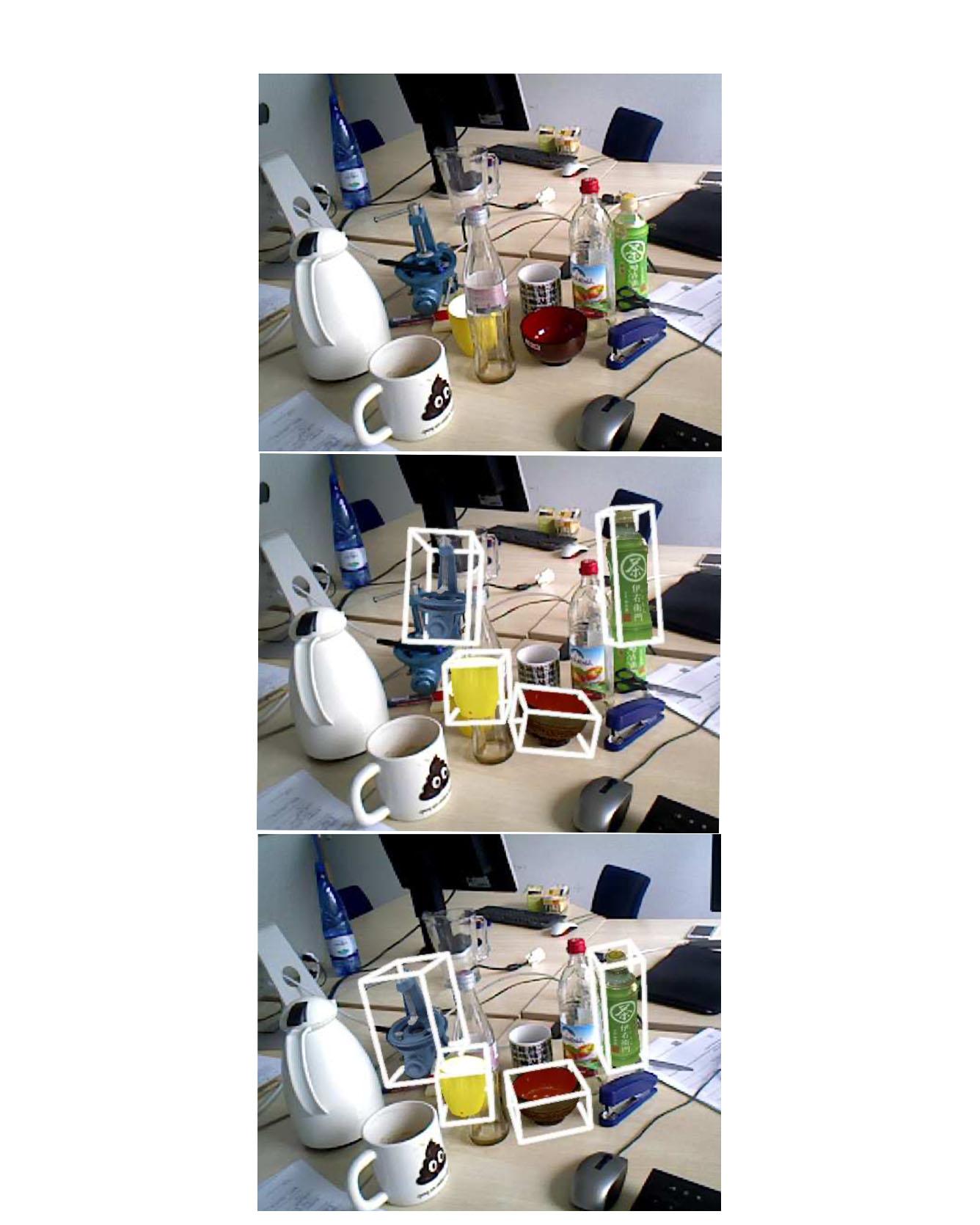
We present a novel approach for model-based 6D pose refinement in color data. Building on the established idea of contour-based pose tracking, we teach a deep neural network to predict a translational and rotational update. At the core, we propose a new visual loss that drives the pose update by aligning object contours, thus avoiding the definition of any explicit appearance model. In contrast to previous work our method is correspondence-free, segmentation-free, can handle occlusion and is agnostic to geometrical symmetry as well as visual ambiguities. Additionally, we observe a strong robustness towards rough initialization. The approach can run in real-time and produces pose accuracies that come close to 3D ICP without the need for depth data. Furthermore, our networks are trained from purely synthetic data and will be published together with the refinement code to ensure reproducibility. Read More
Citation: Manhardt, Fabian, Wadim Kehl, Nassir Navab, and Federico Tombari. "Deep model-based 6d pose refinement in rgb." In Proceedings of the European Conference on Computer Vision (ECCV), pp. 800-815. 2018.
TRI Author: Wadim Kehl All Authors:Tomas Hodan, Frank Michel, Eric Brachmann, Wadim Kehl, Anders Buch, Dirk Kraft, Bertram Drost, Joel Vidal, Stephan Ihrke, Xenophon Zabulis, Caner Sahin, Fabian Manhardt, Federico Tombari, Tae-Kyun Kim, Jiri Matas, Carsten Rother
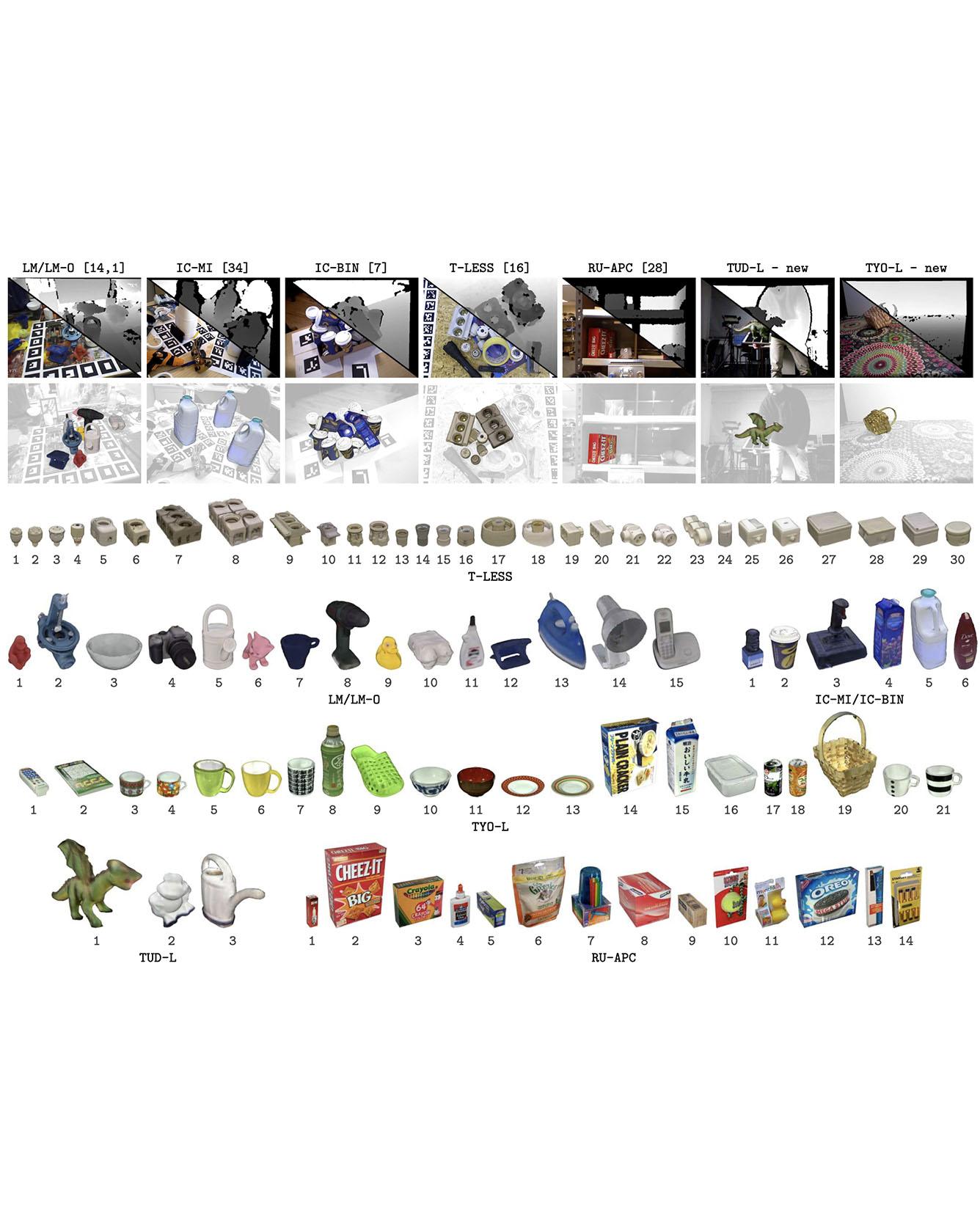
We propose a benchmark for 6D pose estimation of a rigid object from a single RGB-D input image. The training data consists of a texture-mapped 3D object model or images of the object in known 6D poses. The benchmark comprises of: i) eight datasets in a unified format that cover different practical scenarios, including two new datasets focusing on varying lighting conditions, ii) an evaluation methodology with a pose-error function that deals with pose ambiguities, iii) a comprehensive evaluation of 15 diverse recent methods that captures the status quo of the field, and iv) an online evaluation system that is open for continuous submission of new results. The evaluation shows that methods based on point-pair features currently perform best, outperforming template matching methods, learning-based methods and methods based on 3D local features. The project website is available at bop.felk.cvut.cz. Read MoreCitation: Hodan, Tomas, Frank Michel, Eric Brachmann, Wadim Kehl, Anders GlentBuch, Dirk Kraft, Bertram Drost et al. "Bop: Benchmark for 6d object pose estimation." In Proceedings of the European Conference on Computer Vision (ECCV), pp. 19-34. 2018.
TRI Author: Muratahan Aykol
All Authors: Vinay I Hegde, Muratahan Aykol, Scott Kirklin, Chris Wolverton
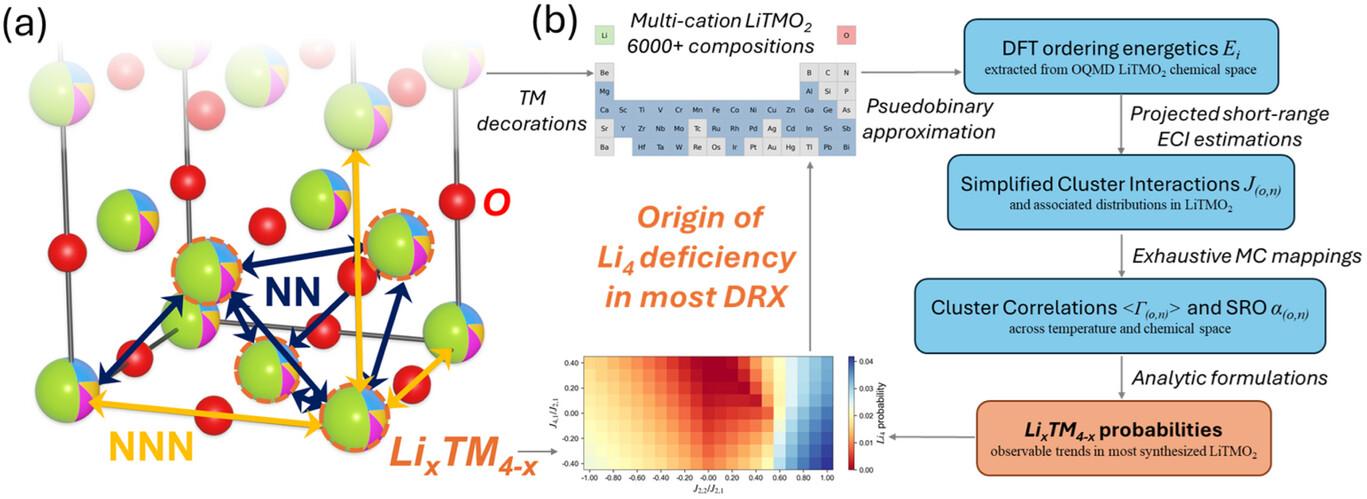
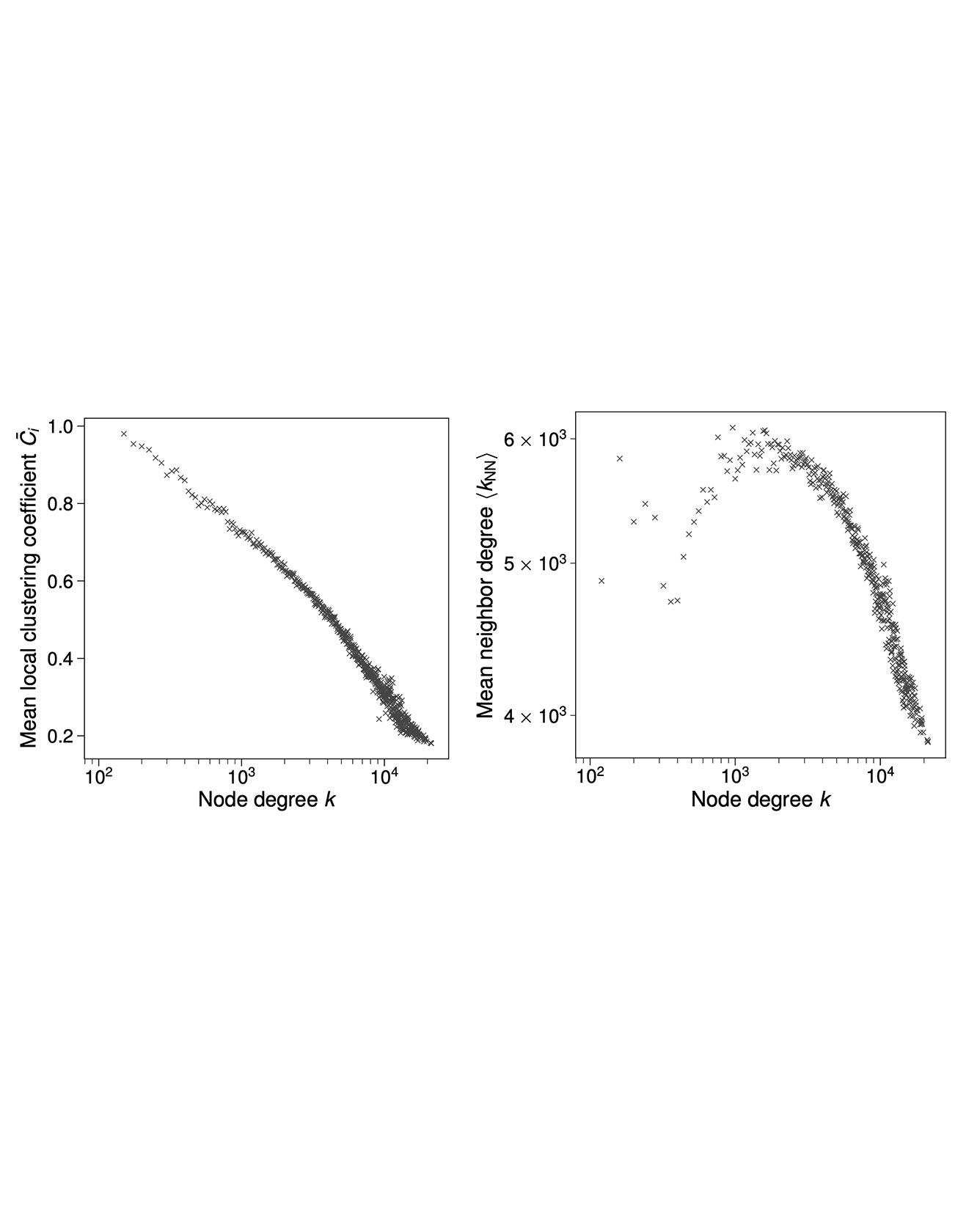
Understanding how the arrangement of atoms and their interactions determine material behavior has been the dominant paradigm in materials science. A complementary approach is studying the organizational structure of networks of materials, defined on the basis of interactions between materials themselves. In this work, we present the "phase diagram of all known inorganic materials", an extremely-dense complex network of nearly 2.1×10⁴ stable inorganic materials (nodes) connected with 41×106 tie-lines (edges) defining their two-phase equilibria, as computed via high-throughput density functional theory. We show that the degree distribution of this network follows a lognormal form, with each material connected to on average 18% of the other materials in the network via tie-lines. Analyzing the structure and topology of this network has potential to uncover new materials knowledge inaccessible from the traditional bottom-up (atoms to materials) approaches. As an example, we derive a data-driven metric for the reactivity of a material as characterized by its connectedness in the network, and quantitatively identify the noblest materials in nature. Read more
Citation: Hegde, Vinay I., Muratahan Aykol, Scott Kirklin, and Chris Wolverton. "The phase diagram of all inorganic materials." In Science Advances, arXiv preprint arXiv:1808.10869 (2018).
TRI Author: Simon Stent
All Authors: Xishuai Peng, Ruirui Liu, Yi Lu Murphey, Simon Stent, Yuanxiang Li
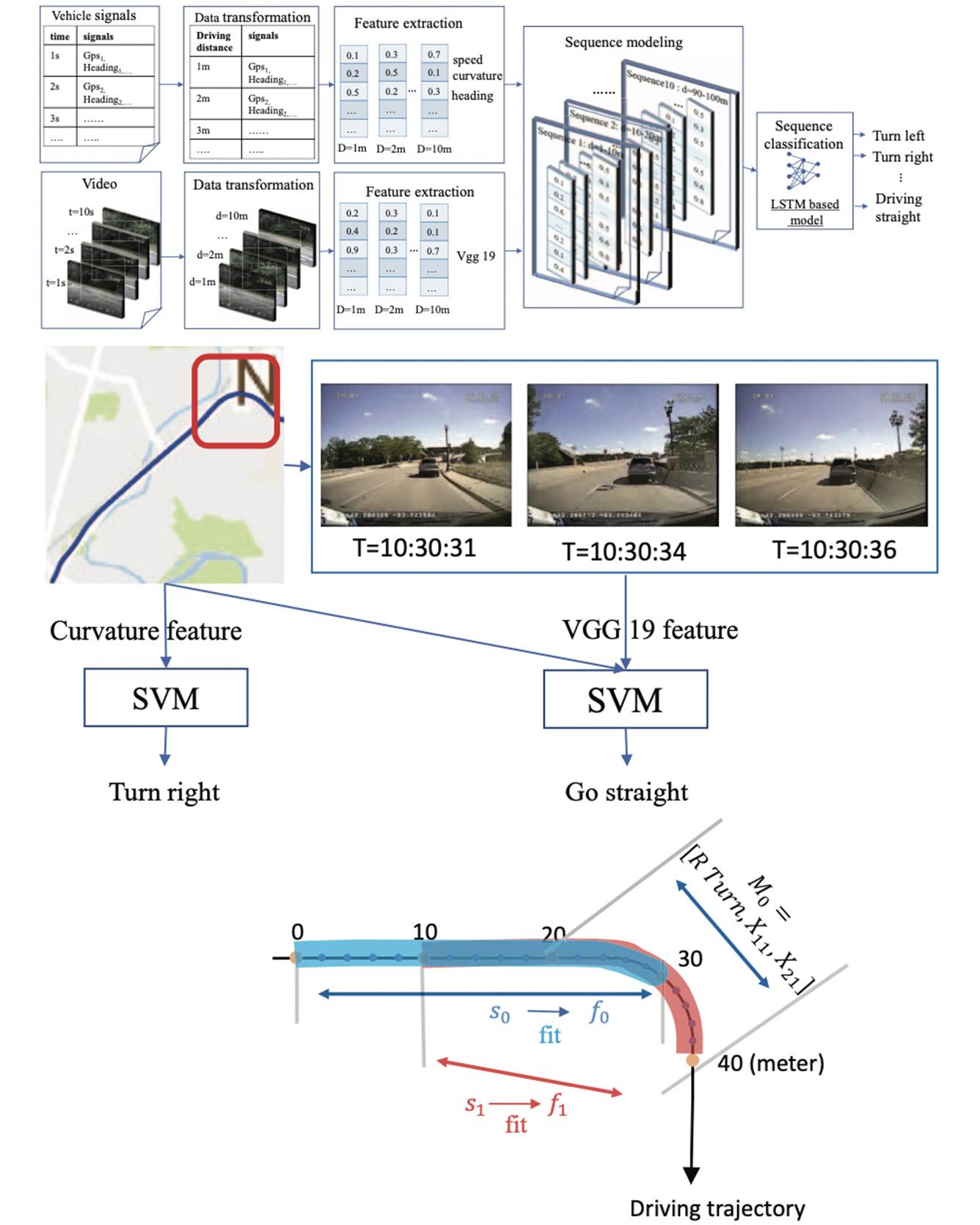
Driving maneuver detection is one of the most challenging tasks in Advanced Driver Assistance Systems (ADAS). Research has shown that the early notification of improper driving maneuvers is helpful to avoid fatalities and serious accidents. In this paper, we introduce a driver maneuvering detection (DMD) system. The DMD system contains three major computational components, distance based representation of driving context, combined features of vehicle trajectory and VGG-19 network features extracted from the video images of vehicle front view, and a Long Short-Term Memory (LSTM)-based neural network model to learn sequence knowledge in driving maneuvering events. We show through experiments that the DMD system is capable of learning the latent features of five different classes of driving maneuvers and achieving significantly better performance than traditional classification methods on real-world driving trips. Read More
Citation: Peng, Xishuai, Ruirui Liu, Yi Lu Murphey, Simon Stent, and Yuanxiang Li. "Driving maneuver detection via sequence learning from vehicle signals and video images." In 2018 24th International Conference on Pattern Recognition (ICPR), pp. 1265-1270. IEEE, 2018.
TRI Author: Hongkai Dai
All Authors: Romeo Orsolino, Michele Focchi, Carlos Mastalli, Hongkai Dai, Darwin G. Caldwell and Claudio Semini
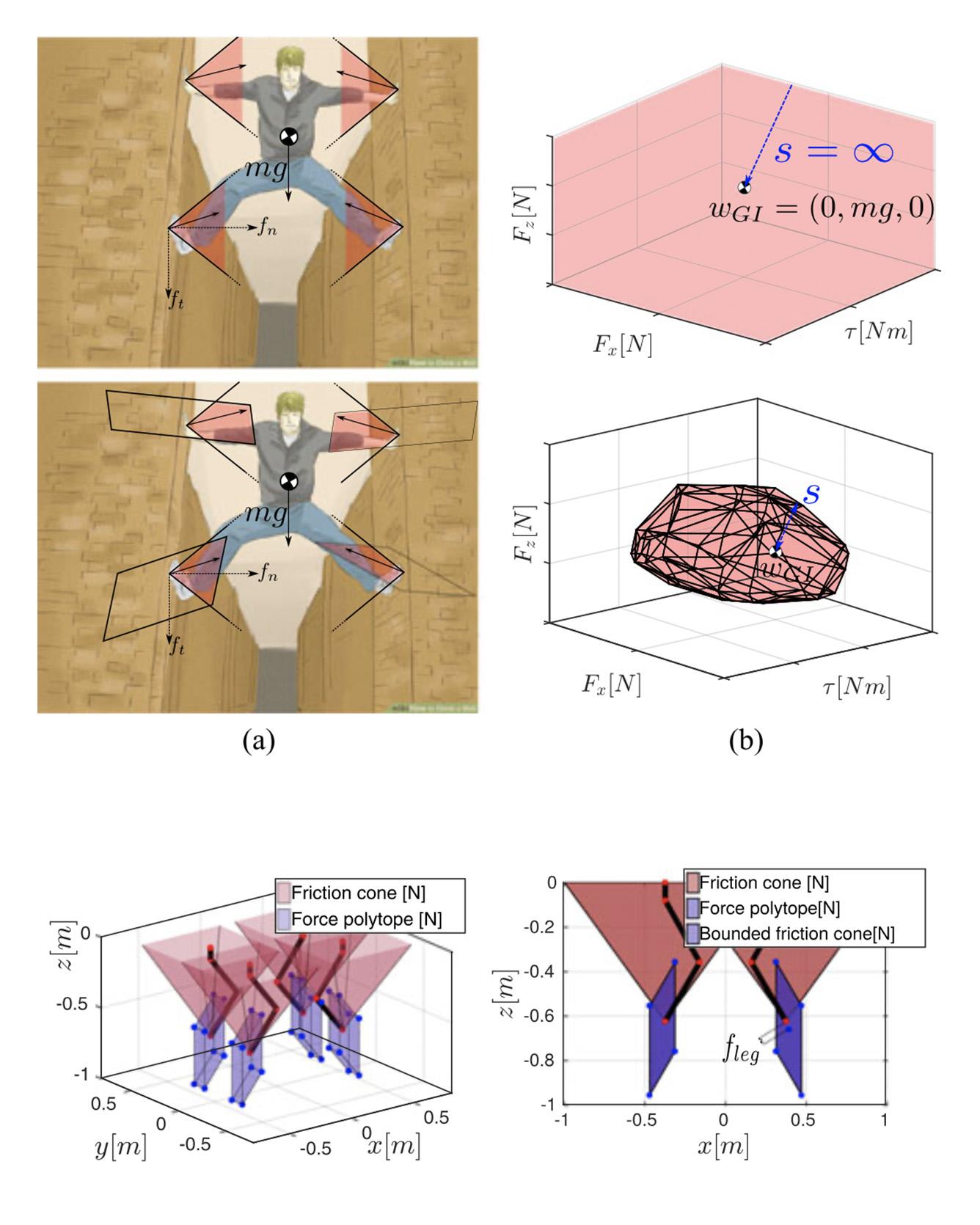
Motion planning in multicontact scenarios has recently gathered interest within the legged robotics community, however actuator force/torque limits are rarely considered. We believe that these limits gain paramount importance when the complexity of the terrains to be traversed increases. We build on previous research from the field of robotic grasping to propose two new six-dimensional bounded polytopes named the Actuation Wrench Polytope (AWP) and the Feasible Wrench Polytope (FWP). We define theAWP as the set of all the wrenches that a robot can generate while considering its actuation limits. This considers the admissible contact forces that the robot can generate given its current configuration and actuation capabilities. The Contact Wrench Cone (CWC) instead includes features of the environment such as the contact normal or the friction coefficient. The intersection of the AWP and of the CWC results in a convex polytope, the FWP, which turns out to be more descriptive of the real robot capabilities than existing simplified models, while maintaining the same compact representation. We explain how to efficiently compute the vertex-description of the FWP that is then used to evaluate a feasibility factor that we adapted from the field of robotic grasping. This allows us to optimize for robustness to external disturbance wrenches. Based on this, we present an implementation of a motion planner for our quadruped robot HyQ that provides online Center of Mass trajectories that are guaranteed to be statically stable and actuation-consistent. Read More
Citation: Orsolino, Romeo, Michele Focchi, Carlos Mastalli, Hongkai Dai, Darwin G. Caldwell, and Claudio Semini. "Application of wrench-based feasibility analysis to the online trajectory optimization of legged robots." IEEE Robotics and Automation Letters 3, no. 4 (2018): 3363-3370.
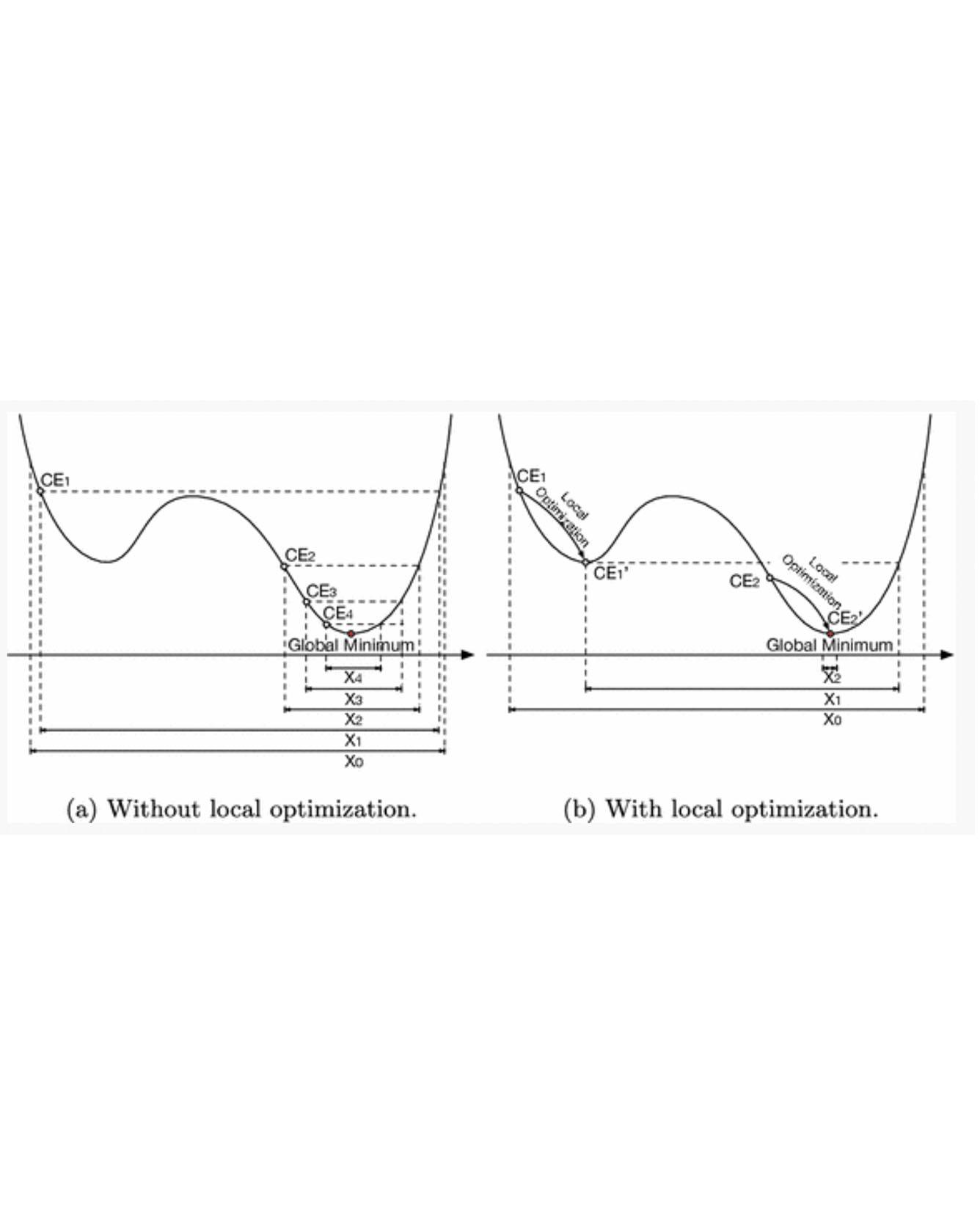
TRI Author: Soonho Kong All Authors: Soonho Kong, Armando Solar-Lezama, Sicun Gao We propose δ-complete decision procedures for solving satisfiability of nonlinear SMT problems over real numbers that contain universal quantification and a wide range of nonlinear functions. The methods combine interval constraint propagation, counterexample-guided synthesis, and numerical optimization. In particular, we show how to handle the interleaving of numerical and symbolic computation to ensure delta-completeness in quantified reasoning. We demonstrate that the proposed algorithms can handle various challenging global optimization and control synthesis problems that are beyond the reach of existing solvers. Read more
Citation: Kong, Soonho, Armando Solar-Lezama, and Sicun Gao. "Delta-decision procedures for exists-forall problems over the reals." In International Conference on Computer Aided Verification, pp. 219-235. Springer, Cham, 2018.
TRI Author: Adrien Gaidon
All Authors: Adrien Gaidon, Antonio Lopez, Florent Perronnin
The recent successes in many visual recognition tasks, such as image classification, object detection, and semantic segmentation can be attributed in large part to three factors: (i) advances in end-to-end trainable deep learning models (LeCun 2015), (ii) the progress of computing hardware, and (iii) the introduction of increasingly larger labeled datasets such as PASCAL VOC (Everingham et al. 2010), KITTI (Geiger et al. 2012), ImageNet (Russakovsky et al. 2015), MS-COCO (Lin et al. 2014), and Cityscapes (Cordts et al. 2016), among others. In fact, recent results (Sun et al. 2017; Hestness et al. 2017) indicate that the reliability of current visual models might not be limited by the algorithms themselves but by the type and amount of supervised data available. Therefore, to tackle more challenging tasks, such as video scene understanding, progress is needed not only on the algorithmic and hardware fronts but also on the data front, both for learning and quantitative evaluation. However, acquiring and densely labeling a large visual dataset with ground truth information (e.g. semantic labels, depth, optical flow) for each new problem is not a scalable alternative. Read More
Citation: Gaidon, Adrien, Antonio Lopez, and Florent Perronnin. "The reasonable effectiveness of synthetic visual data." International Journal of Computer Vision 126, no. 9 (2018): 899-901.

TRI Author: Hongkai Dai
All Authors: Bernardo Aceituno-Cabezas, Carlos Mastalli, Hongkai Dai, Michele Focchi, Andreea Radulescu, Darwin G. Caldwell, Jose Cappelletto, Juan C. Grieco, Gerardo Fernandez-Lopez, Claudio Semini
Traditional motion planning approaches for multilegged locomotion divide the problem into several stages, such as contact search and trajectory generation. However, reasoning about contacts and motions simultaneously is crucial for the generation of complex whole-body behaviors. Currently, coupling theses problems has required either the assumption of a fixed gait sequence and flat terrain condition, or nonconvex optimization with intractable computation time. In this letter, we propose a mixed-integer convex formulation to plan simultaneously contact locations, gait transitions, and motion, in a computationally efficient fashion. In contrast to previous works, our approach is not limited to flat terrain nor to a prespecified gait sequence. Instead, we incorporate the friction cone stability margin, approximate the robot's torque limits, and plan the gait using mixed-integer convex constraints. We experimentally validated our approach on the HyQ robot by traversing different challenging terrains, where nonconvexity and flat terrain assumptions might lead to suboptimal or unstable plans. Our method increases the motion robustness while keeping a low computation time. Read More
Citation: Aceituno-Cabezas, Bernardo, Carlos Mastalli, Hongkai Dai, Michele Focchi, Andreea Radulescu, Darwin G. Caldwell, José Cappelletto, Juan C. Grieco, Gerardo Fernández-López, and Claudio Semini. "Simultaneous contact, gait, and motion planning for robust multilegged locomotion via mixed-integer convex optimization." IEEE Robotics and Automation Letters 3, no. 3 (2017): 2531-2538.
TRI Authors: Kuan-Hui Lee, Yusuke Kanzawa, Matthew Derry
All Authors: Kuan-Hui Lee, Yusuke Kanzawa, Matthew Derry, and Michael R. James
This paper proposes the Permutation Matrix Track Association (PMTA) algorithm to support track-to-track, multi-sensor data fusion for multiple targets in an autonomous driving system. In this system, measurement data from different sensor modalities (LIDAR, radar, and vision) is processed by object trackers operating on each sensor modality independently to create the tracks of the objects. The proposed approach fuses the object track lists from each tracker, first by associating the tracks within each track list, followed by a state estimation (filtering) step. The eventual output is the unified tracks of the objects provided for further autonomous driving processing, such as path and motion planning. The permutation matrix track association (PMTA) algorithm considers both spatial and temporal information to associate object tracks from different sensor modalities. Experimental results show that the proposed approach improves not only the performance of the multipletarget track-to-track fusion, but also stability and robustness in the resulting speed control and decision making in the autonomous driving system. Read More
Citation: Lee, Kuan-Hui, Yusuke Kanzawa, Matthew Derry, and Michael R. James. "Multi-target track-to-track fusion based on permutation matrix track association." In 2018 IEEE Intelligent Vehicles Symposium (IV), pp. 465-470. IEEE, 2018.
TRI Author: Wadim Kehl All Authors: Miroslava Slavcheva, Wadim Kehl, Nassir Navab, Slobodan Ilic We tackle the task of dense 3D reconstruction from RGB-D data. Contrary to the majority of existing methods, we focus not only on trajectory estimation accuracy, but also on reconstruction precision. The key technique is SDF-2-SDF registration, which is a correspondence-free, symmetric, dense energy minimization method, performed via the direct voxel-wise difference between a pair of signed distance fields. It has a wider convergence basin than traditional point cloud registration and cloud-to-volume alignment techniques. Furthermore, its formulation allows for straightforward incorporation of photometric and additional geometric constraints. We employ SDF-2-SDF registration in two applications. First, we perform small-to-medium scale object reconstruction entirely on the CPU. To this end, the camera is tracked frame-to-frame in real time. Then, the initial pose estimates are refined globally in a lightweight optimization framework, which does not involve a pose graph. We combine these procedures into our second, fully real-time application for larger-scale object reconstruction and SLAM. It is implemented as a hybrid system, whereby tracking is done on the GPU, while refinement runs concurrently over batches on the CPU. To bound memory and runtime footprints, registration is done over a fixed number of limited-extent volumes, anchored at geometry-rich locations. Extensive qualitative and quantitative evaluation of both trajectory accuracy and model fidelity on several public RGB-D datasets, acquired with various quality sensors, demonstrates higher precision than related techniques. Read more
Citation: Slavcheva, Miroslava, Wadim Kehl, Nassir Navab, and Slobodan Ilic. "Sdf-2-sdf registration for real-time 3d reconstruction from rgb-d data." International Journal of Computer Vision 126, no. 6 (2018): 615-636.