Featured Publications
All Publications

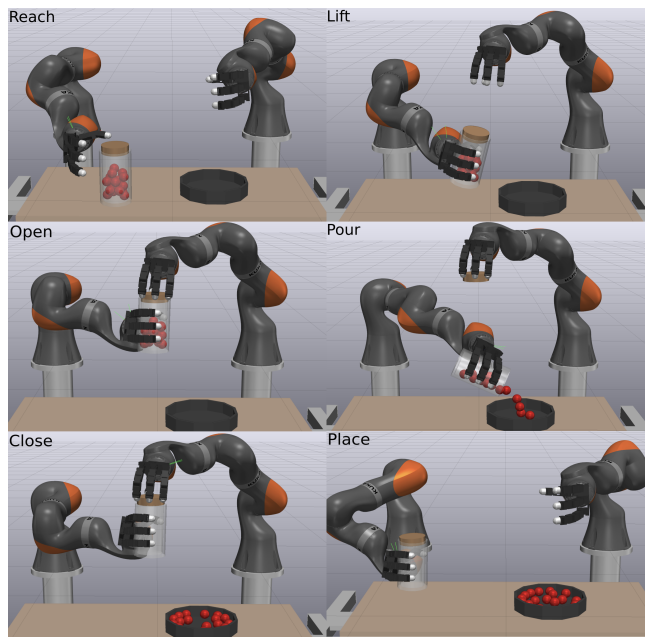
We present a convex formulation of compliant frictional contact and a robust, performant method to solve it in practice. By analytically eliminating contact constraints, we obtain an unconstrained convex problem. Our solver has proven global convergence and warm-starts effectively, enabling simulation at interactive rates. We develop compact analytical expressions of contact forces allowing us to describe our model in clear physical terms and to rigorously characterize our approximations. Moreover, this enables us not only to model point contact, but also to incorporate sophisticated models of compliant contact patches. Our time stepping scheme includes the midpoint rule, which we demonstrate achieves second order accuracy even with frictional contact. We introduce a number of accuracy metrics and show our method outperforms existing commercial and open source alternatives without sacrificing accuracy. Finally, we demonstrate robust simulation of robotic manipulation tasks at interactive rates, with accurately resolved stiction and contact transitions, as required for meaningful sim-to-real transfer. Our method is implemented in the open source robotics toolkit Drake. READ MORE
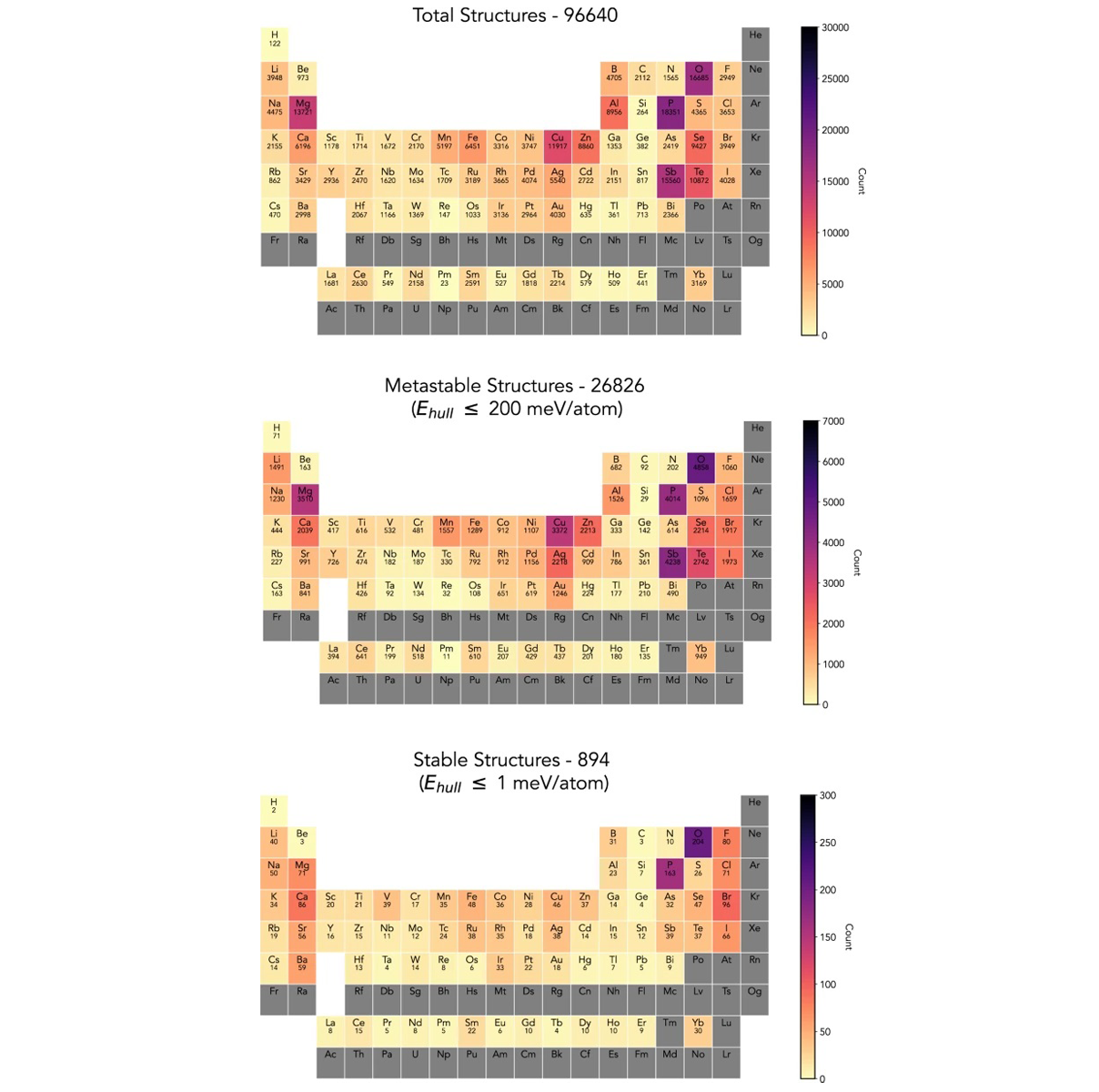
We report a dataset of 96640 crystal structures discovered and computed using our previously published autonomous, density functional theory (DFT) based, active-learning workflow named CAMD (Computational Autonomy for Materials Discovery). Of these, 894 are within 1 meV/atom of the convex hull and 26826 are within 200 meV/atom of the convex hull. The dataset contains DFT-optimized pymatgen crystal structure objects, DFT-computed formation energies and phase stability calculations from the convex hull. It contains a variety of spacegroups and symmetries derived from crystal prototypes derived from known experimental compounds, and was generated from active learning campaigns of various chemical systems. This dataset can be used to benchmark future active-learning or generative efforts for structure prediction, to seed new efforts of experimental crystal structure discovery, or to construct new models of structure-property relationships. READ MORE
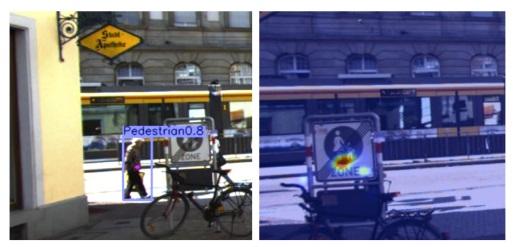
This paper proposes a self-supervised objective for learning representations that localize objects under occlusion - a property known as object permanence. A central question is the choice of learning signal in cases of total occlusion. Rather than directly supervising the locations of invisible objects, we propose a self-supervised objective that requires neither human annotation, nor assumptions about object dynamics. We show that object permanence can emerge by optimizing for temporal coherence of memory: we fit a Markov walk along a space-time graph of memories, where the states in each time step are non-Markovian features from a sequence encoder. This leads to a memory representation that stores occluded objects and predicts their motion, to better localize them. The resulting model outperforms existing approaches on several datasets of increasing complexity and realism, despite requiring minimal supervision, and hence being broadly applicable. READ MORE
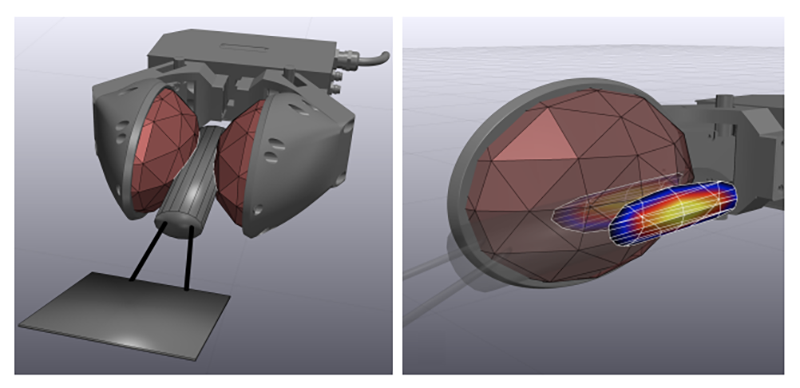
Pressure Field Contact (PFC) was recently introduced as a method for detailed modeling of contact interface regions at rates much faster than elasticity-theory models, while at the same time predicting essential trends and capturing rich contact behavior. The PFC model was designed to work in conjunction with error-controlled integration at the acceleration level. Therefore a vast majority of existent multibody codes using solvers at the velocity level cannot incorporate PFC in its original form. In this work we introduce a discrete in time approximation of PFC making it suitable for use with existent velocity-level time steppers and enabling execution at real-time rates. We evaluate the accuracy and performance gains of our approach and demonstrate its effectiveness in simulating relevant manipulation tasks. The method is available in open source as part of Drake’s Hydroelastic Contact model. READ MORE
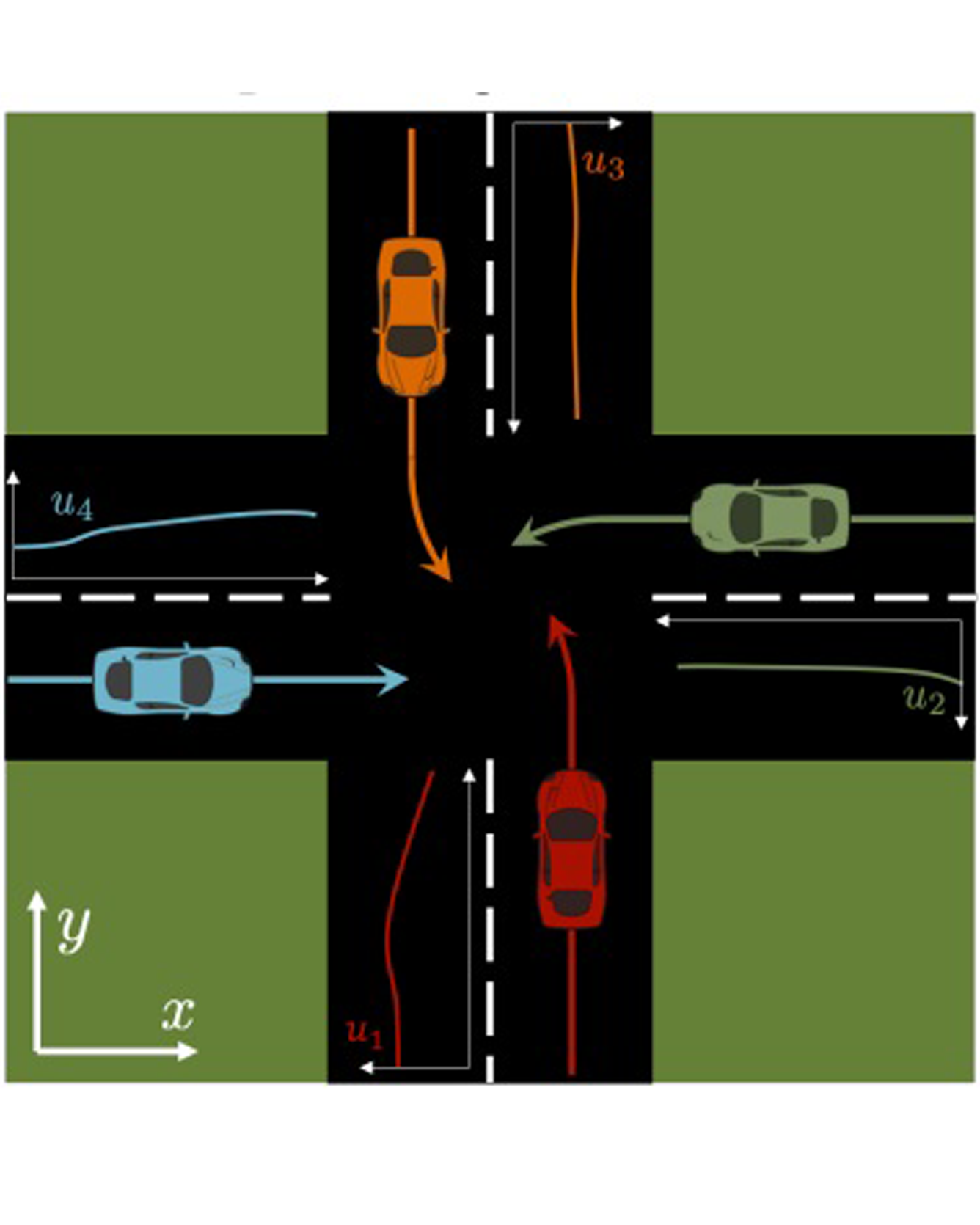
We focus on decentralized navigation among multiple noncommunicating agents at uncontrolled street intersections. Avoiding collisions under such settings demands nuanced implicit coordination. This is challenging to accomplish; the high dimensionality of the space of possible behavior and the lack of explicit communication among agents complicate prediction and planning. However, the structure of these domains often collapses the space of possible collective behavior into a finite set of modes. Our key insight is that enabling agents to reason about modes may enable them to coordinate implicitly via intent signals encoded in their actions. In this paper, we represent modes as low-dimensional multiagent motion primitives in a compact and interpretable fashion using the formalism of topological braids. Based on this representation, we derive a probabilistic model that maps past behavior of multiple agents to a future mode. Using this model, we design a decentralized control algorithm that treats navigation as uncertainty minimization over the space of modes. This algorithm enables agents to collectively reject unsafe intersection crossing strategies in a distributed fashion. We demonstrate our approach in a simulated four-way uncontrolled intersection. Our model is shown to reduce the frequency of collisions by over 65% against baselines explicitly reasoning in the space of trajectories, while maintaining comparable time efficiency in challenging scenarios. READ MORE
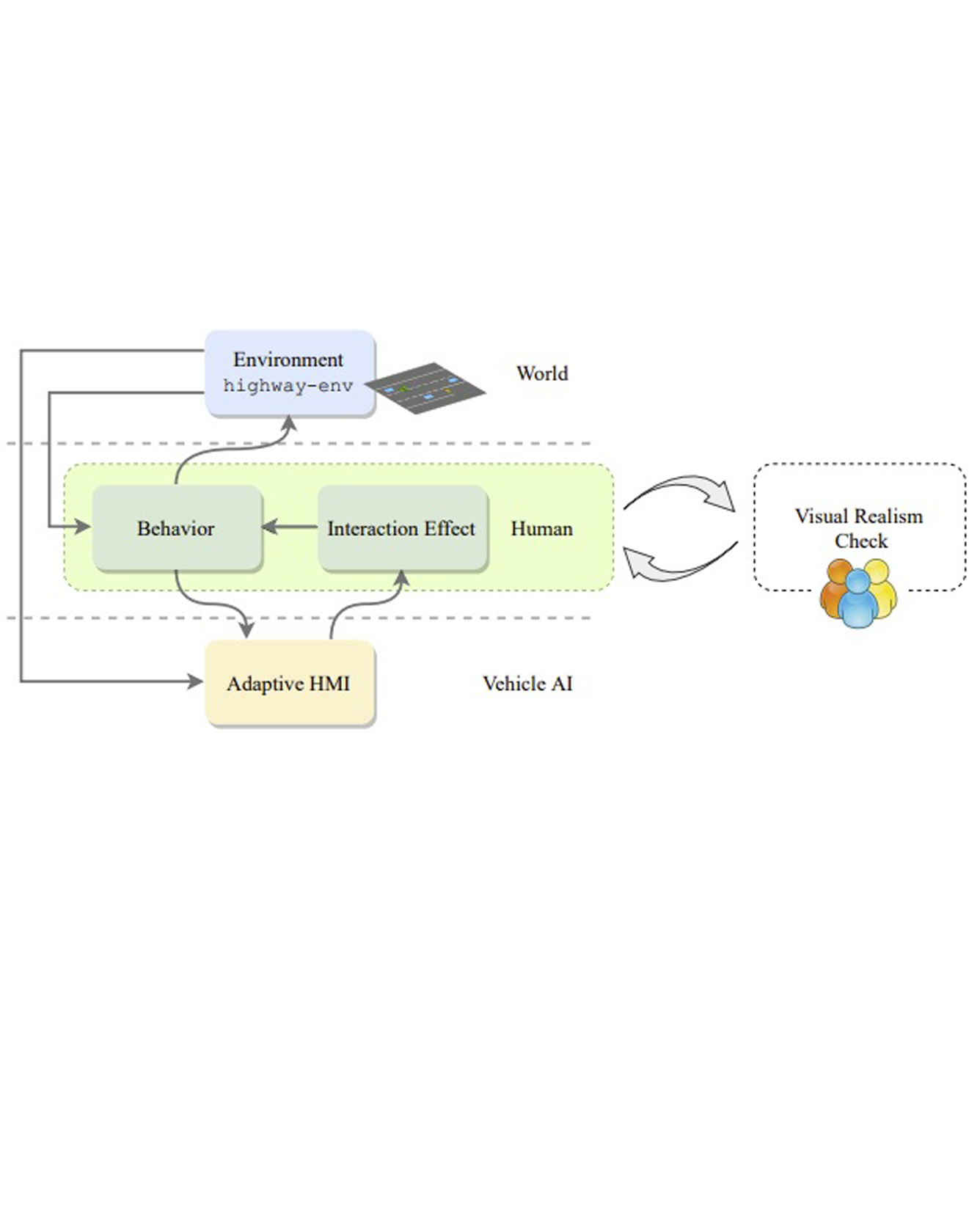
We introduce a lightweight simulation and modeling framework, HMIway-env, for studying human-machine teaming in the context of driving. The goal of the framework is to accelerate the development of adaptive AI systems which can respond to individual driver states, traits, and preferences, by serving as a data-generation engine and training environment for learning personalized human-AI teaming policies. We extend highway-env, an OpenAI Gym-based simulator environment, to enable specification of human driver behavior, and design of vehicle-driver interactions and outcomes. We describe one instance of our framework incorporating models for distracted and cautious driving, which we validate through crowd-sourced feedback, and show early experimental results toward the training of better intervention policies. READ MORE
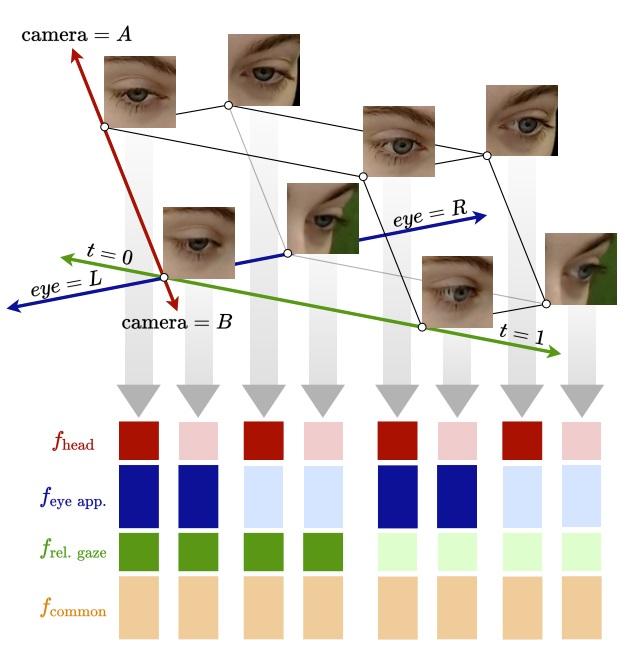
We present a method for unsupervised gaze representation learning from multiple synchronized views of a person's face. The key assumption is that images of the same eye captured from different viewpoints differ in certain respects while remaining similar in others. Specifically, the absolute gaze and absolute head pose of the same subject should be different from different viewpoints, while appearance characteristics and gaze angle relative to the head coordinate frame should remain constant. To leverage this, we adopt a cross-encoder learning framework, in which our encoding space consists of head pose, relative eye gaze, eye appearance and other common features. Image pairs which are assumed to have matching subsets of features should be able to swap those subsets among themselves without any loss of information, computed by decoding the mixed features back into images and measuring reconstruction loss. We show that by applying these assumptions to an unlabelled multi-view video dataset, we can generate more powerful representations than a standard gaze cross-encoder for few-shot gaze estimation. Furthermore, we introduce a new feature-mixing method which results in higher performance, faster training, improved testing flexibility with multiple views, and added interpretability with learned confidence. READ MORE
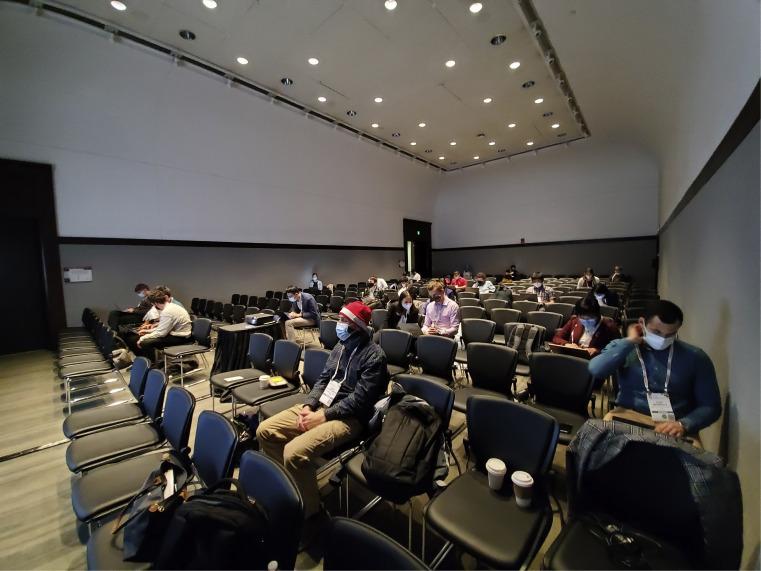
The growing field of data-driven materials research poses a challenge to educators: teaching machine learning to materials scientists. We share our recent experiences and lessons learnt from organizing educational sessions at the fall 2021 meeting of the Materials Research Society. READ MORE
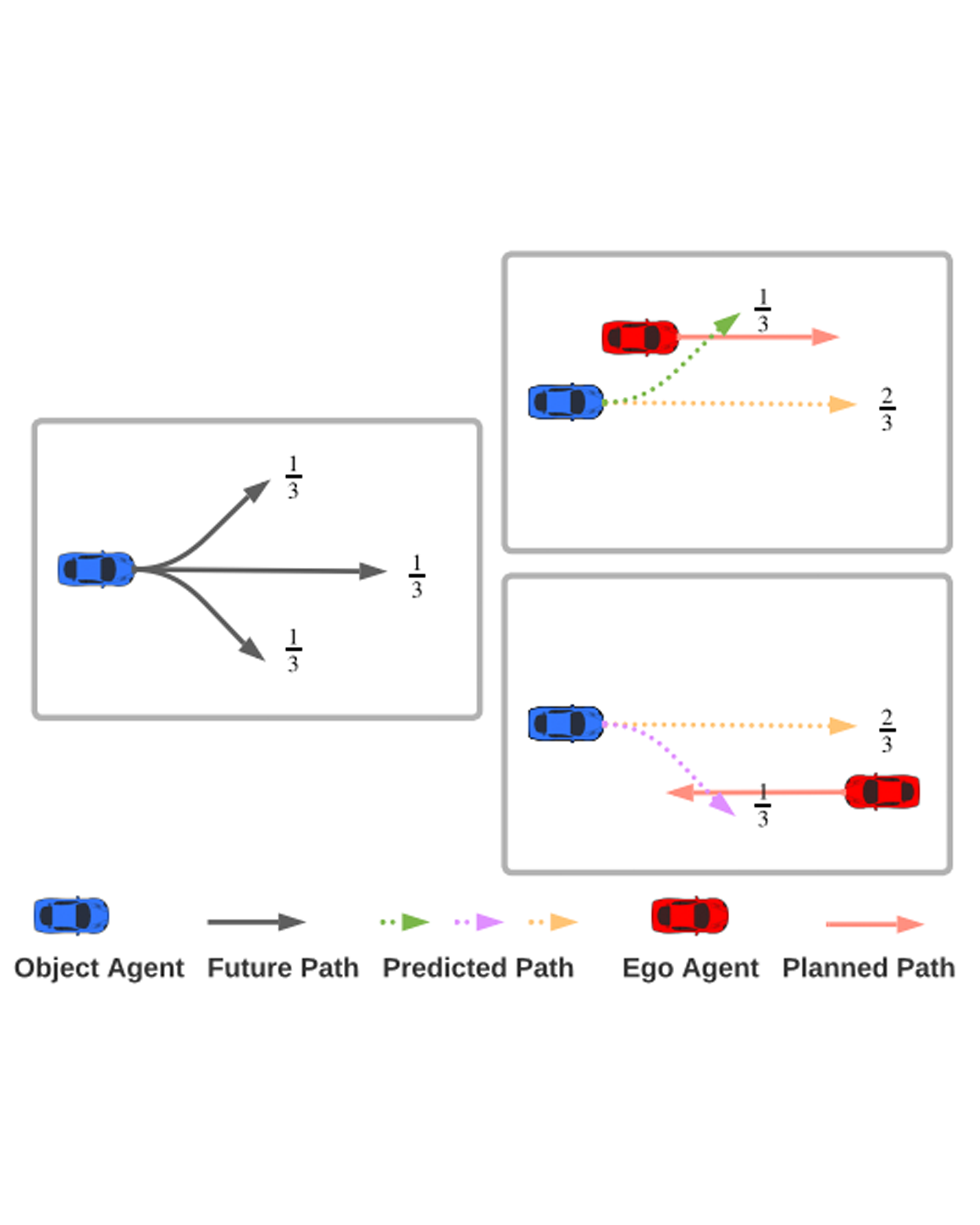
When predicting trajectories of road agents, motion predictors usually approximate the future distribution by a limited number of samples. This constraint requires the predictors to generate samples that best support the task given task specifications. However, existing predictors are often optimized and evaluated via task-agnostic measures without accounting for the use of predictions in downstream tasks, and thus could result in sub-optimal task performance.
In this paper, we propose a task-informed motion prediction model that better supports the tasks through its predictions, by jointly reasoning about prediction accuracy and the utility of the downstream tasks, which is commonly used to evaluate the task performance. The task utility function does not require the full task information, but rather a specification of the utility of the task, resulting in predictors that serve a wide range of downstream tasks. We demonstrate our approach on two use cases of common decision making tasks and their utility functions, in the context of autonomous driving and parallel autonomy. Experiment results show that our predictor produces accurate predictions that improve the task performance by a large margin in both tasks when compared to task-agnostic baselines on the Waymo Open Motion dataset. READ MORE
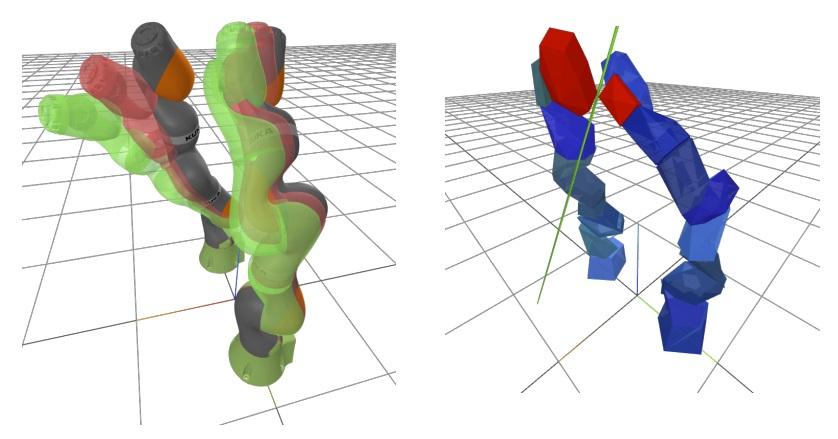
Configuration space (C-space) has played a central role in collision-free motion planning, particularly for robot manipulators. While it is possible to check for collisions at a point using standard algorithms, to date no practical method exists for computing collision-free C-space regions with rigorous certificates due to the complexities of mapping task-space obstacles through the kinematics. In this work, we present the first to our knowledge method for generating such regions and certificates through convex optimization. Our method, called C-Iris (C-space Iterative Regional Inflation by Semidefinite programming), generates large, convex polytopes in a rational parametrization of the configuration space which are guaranteed to be collision-free. Such regions have been shown to be useful for both optimization-based and randomized motion planning. Our regions are generated by alternating between two convex optimization problems: (1) a simultaneous search for a maximal-volume ellipse inscribed in a given polytope and a certificate that the polytope is collision-free and (2) a maximal expansion of the polytope away from the ellipse which does not violate the certificate. The volume of the ellipse and size of the polytope are allowed to grow over several iterations while being collision-free by construction. Our method works in arbitrary dimensions, only makes assumptions about the convexity of the obstacles in the task space, and scales to realistic problems in manipulation. We demonstrate our algorithm's ability to fill a non-trivial amount of collision-free C-space in a 3-DOF example where the C-space can be visualized, as well as the scalability of our algorithm on a 7-DOF KUKA iiwa and a 12-DOF bimanual manipulator. READ MORE