Featured Publications
All Publications

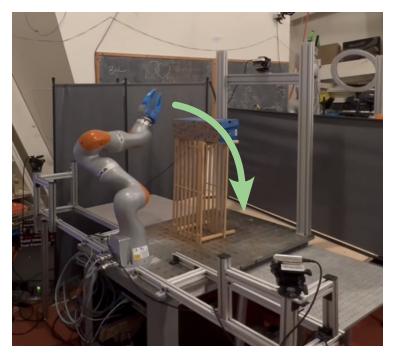
Abstract: In this work, we leverage GPUs to construct probabilistically collision-free convex sets in robot configuration space on the fly. This extends the use of modern motion planning algorithms that leverage such representations to changing environments. These planners rapidly and reliably optimize high-quality trajectories, without the burden of challenging nonconvex collision-avoidance constraints. We present an algorithm that inflates collision-free piecewise linear paths into sequences of convex sets (SCS) that are probabilistically collision-free using massive parallelism. We then integrate this algorithm into a motion planning pipeline, which leverages dynamic roadmaps to rapidly find one or multiple collision-free paths, and inflates them. We then optimize the trajectory through the probabilistically collision-free sets, simultaneously using the candidate trajectory to detect and remove collisions from the sets. We demonstrate the efficacy of our approach on a simulation benchmark and a KUKA iiwa 7 robot manipulator with perception in the loop. On our benchmark, our approach runs 17.1 times faster and yields a 27.9% increase in reliability over the nonlinear trajectory optimization baseline, while still producing high-quality motion plans. Website: https://sites.google.com/view/GPUPolytopes
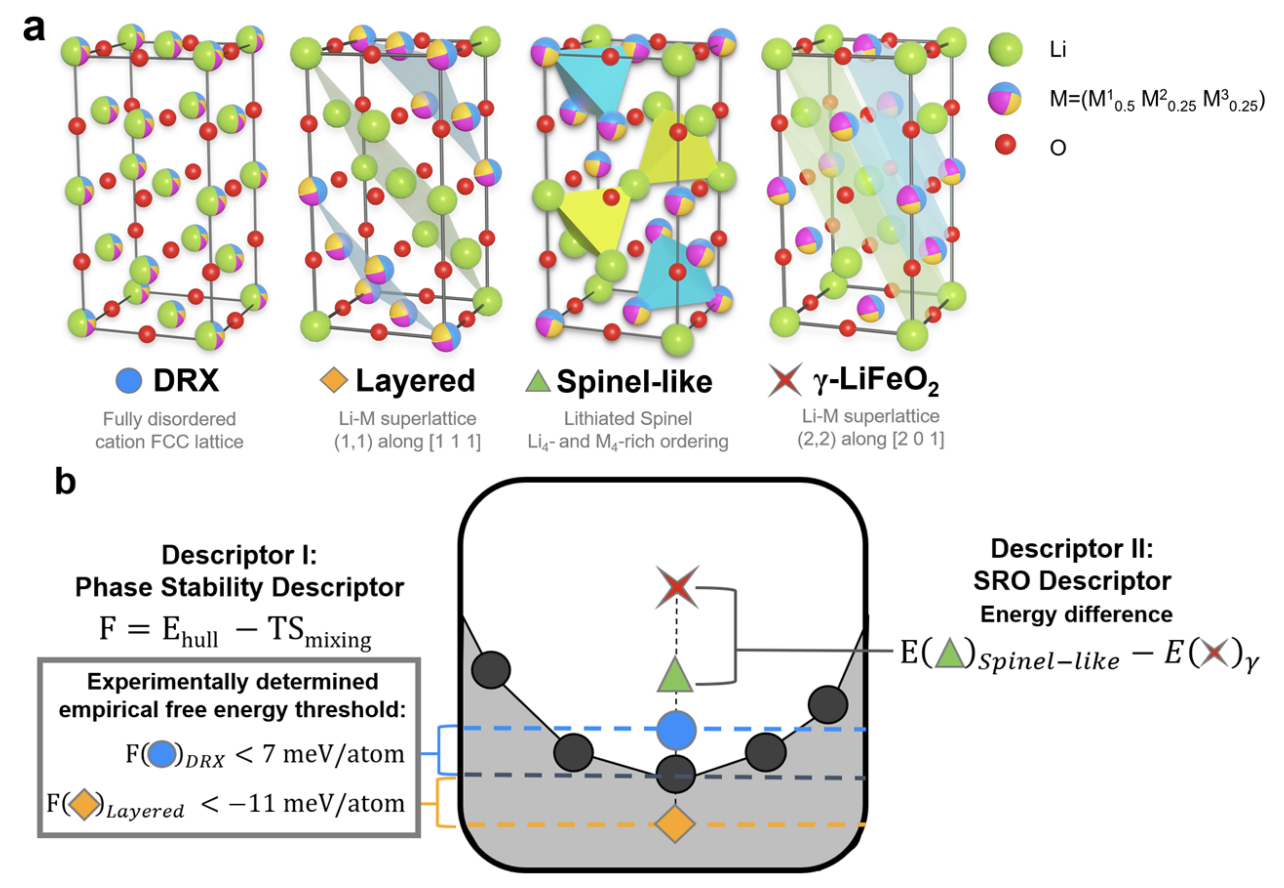
Newly designed Li-ion battery cathode materials with high capacity and greater flexibility in chemical composition will be critical for the growing electric vehicles market. Cathode structures with cation disorder were once considered suboptimal, but recent demonstrations have highlighted their potential in Li1+xM1−xO2 chemistries with a wide range of metal combinations M. By relaxing the strict requirements of maintaining ordered Li diffusion pathways, countless multi-metal compositions in LiMO2 may become viable, aiding the quest for high-capacity cobalt-free cathodes. A challenge presented by this freedom in composition space is designing compositions which possess specific, tailored types of both long- and short-range orderings, which can ensure both phase stability and Li diffusion. However, the combinatorial complexity associated with local cation environments impedes the development of general design guidelines for favorable orderings. Here we propose ordering design frameworks from computational ordering descriptors, which in tandem with low-cost heuristics and elemental statistics can be used to simultaneously achieve compositions that possess favorable phase stability as well as configurations amenable to Li diffusion. Utilizing this computational framework, validated through multiple successful synthesis and characterization experiments, we not only demonstrate the design of LiCr0.75Fe0.25O2, showcasing initial charge capacity of 234 mAhg−1 and 320 mAhg−1 in its 20% Li-excess variant Li1.2Cr0.6Fe0.2O2, but also present the elemental ordering statistics for 32 elements, informed by one of the most extensive first-principles studies of ordering tendencies known to us.
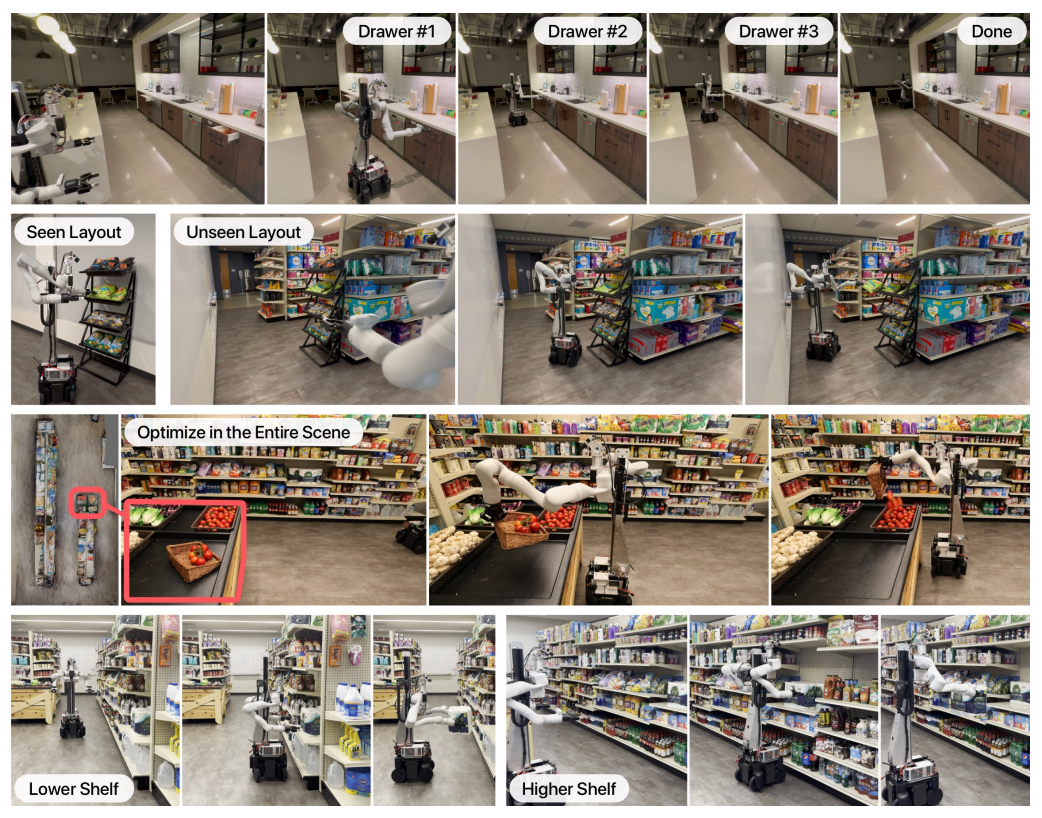
Learned visuomotor policies are capable of performing increasingly complex manipulation tasks. However, most of these policies are trained on data collected from limited robot positions and camera viewpoints. This leads to poor generalization to novel robot positions, which limits the use of these policies on mobile platforms, especially for precise tasks like pressing buttons or turning faucets. In this work, we formulate the policy mobilization problem: find a mobile robot base pose in a novel environment that is in distribution with respect to a manipulation policy trained on a limited set of camera viewpoints. Compared to retraining the policy itself to be more robust to unseen robot base pose initializations, policy mobilization decouples navigation from manipulation and thus does not require additional demonstrations. Crucially, this problem formulation complements existing efforts to improve manipulation policy robustness to novel viewpoints and remains compatible with them. We propose a novel approach for policy mobilization that bridges navigation and manipulation by optimizing the robot's base pose to align with an in-distribution base pose for a learned policy. Our approach utilizes 3D Gaussian Splatting for novel view synthesis, a score function to evaluate pose suitability, and sampling-based optimization to identify optimal robot poses. To understand policy mobilization in more depth, we also introduce the Mobi-π framework, which includes: (1) metrics that quantify the difficulty of mobilizing a given policy, (2) a suite of simulated mobile manipulation tasks based on RoboCasa to evaluate policy mobilization, and (3) visualization tools for analysis. In both our developed simulation task suite and the real world, we show that our approach outperforms baselines, demonstrating its effectiveness for policy mobilization.
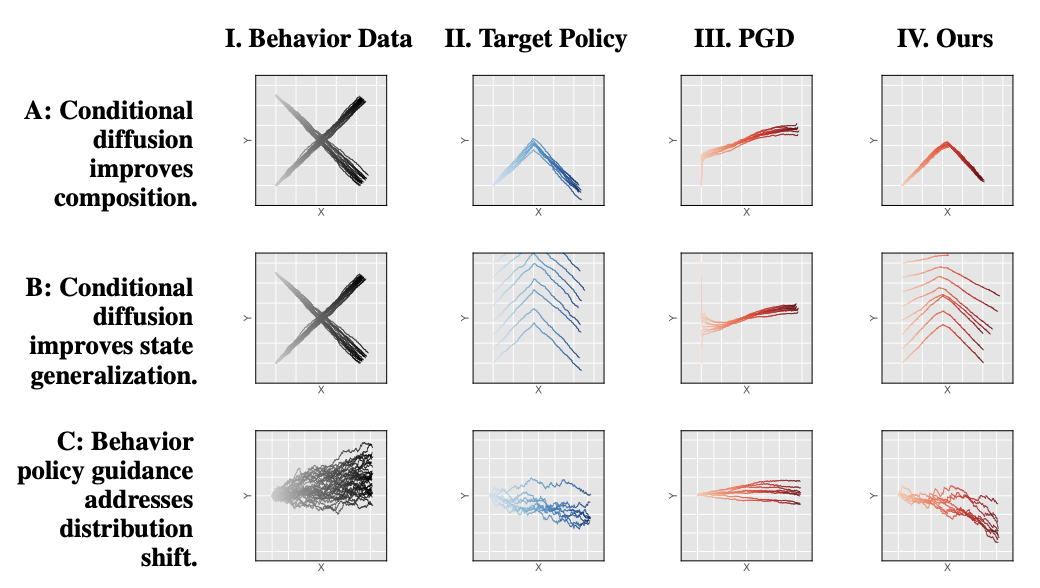
Off-policy evaluation (OPE) estimates the performance of a target policy using offline data collected from a behavior policy, and is crucial in domains such as robotics or healthcare where direct interaction with the environment is costly or unsafe. Existing OPE methods are ineffective for high-dimensional, long-horizon problems, due to exponential blow-ups in variance from importance weighting or compounding errors from learned dynamics models. To address these challenges, we propose STITCH-OPE, a model-based generative framework that leverages denoising diffusion for long-horizon OPE in high-dimensional state and action spaces. Starting with a diffusion model pre-trained on the behavior data, STITCH-OPE generates synthetic trajectories from the target policy by guiding the denoising process using the score function of the target policy. STITCH-OPE proposes two technical innovations that make it advantageous for OPE: (1) prevents over-regularization by subtracting the score of the behavior policy during guidance, and (2) generates long-horizon trajectories by stitching partial trajectories together end-to-end. We provide a theoretical guarantee that under mild assumptions, these modifications result in an exponential reduction in variance versus long-horizon trajectory diffusion. Experiments on the D4RL and OpenAI Gym benchmarks show substantial improvement in mean squared error, correlation, and regret metrics compared to state-of-the-art OPE methods.
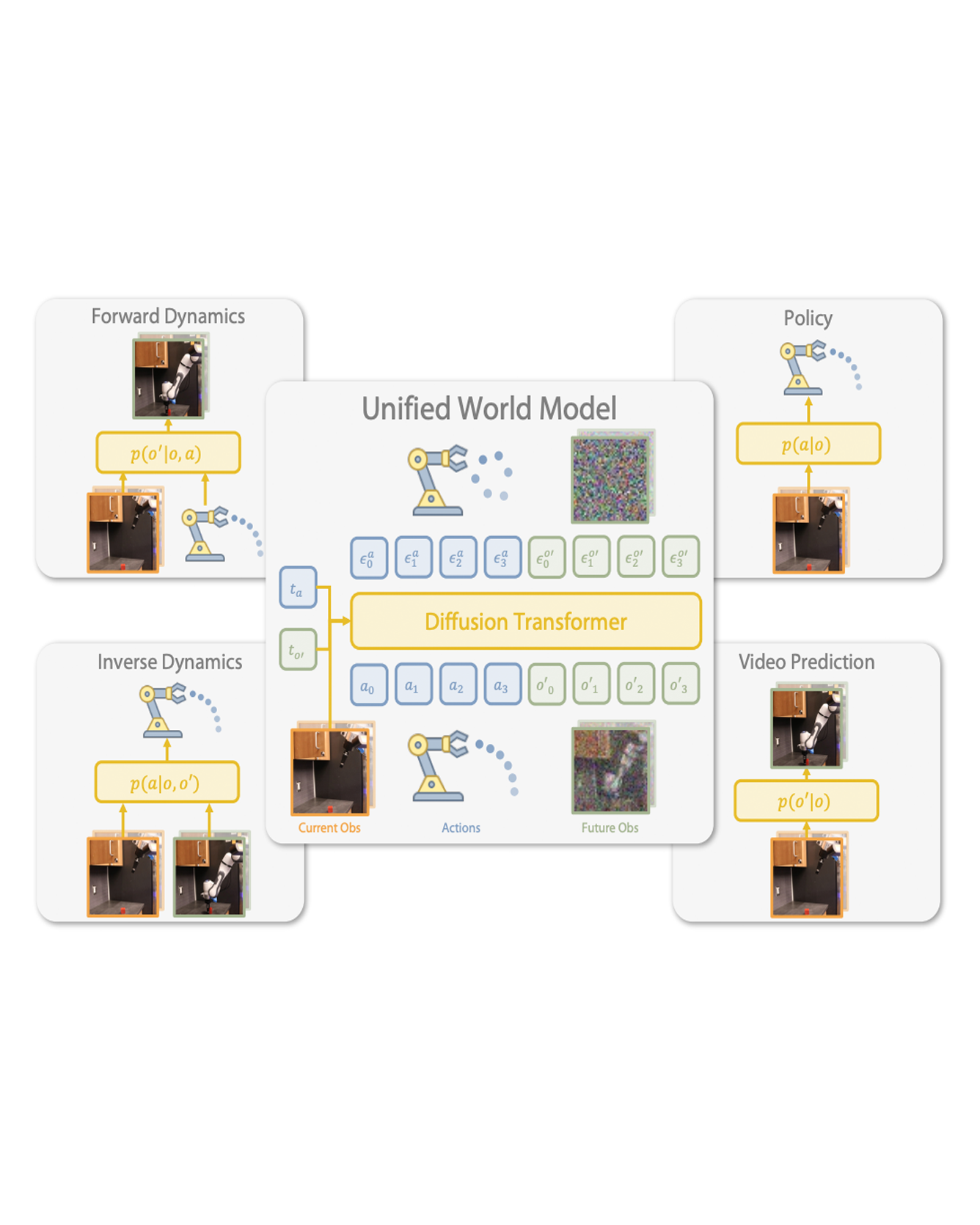
Imitation learning has emerged as a promising approach towards building generalist robots. However, scaling imitation learning for large robot foundation models remains challenging due to its reliance on high-quality expert demonstrations. Meanwhile, large amounts of video data depicting a wide range of environments and diverse behaviors are readily available. This data provides a rich source of information about real-world dynamics and agent-environment interactions. Leveraging this data directly for imitation learning, however, has proven difficult due to the lack of action annotation. In this work, we present Unified World Models (UWM), a framework that allows for leveraging both video and action data for policy learning. Specifically, a UWM integrates an action diffusion process and a video diffusion process within a unified transformer architecture, where independent diffusion timesteps govern each modality. By controlling each diffusion timestep, UWM can flexibly represent a policy, a forward dynamics, an inverse dynamics, and a video generator. Through simulated and real-world experiments, we show that: (1) UWM enables effective pretraining on large-scale multitask robot datasets with both dynamics and action predictions, resulting in more generalizable and robust policies than imitation learning, (2) UWM naturally facilitates learning from action-free video data through independent control of modality-specific diffusion timesteps, further improving the performance of finetuned policies. Our results suggest that UWM offers a promising step toward harnessing large, heterogeneous datasets for scalable robot learning, and provides a simple unification between the often disparate paradigms of imitation learning and world modeling. Videos and code are available at this https URL.
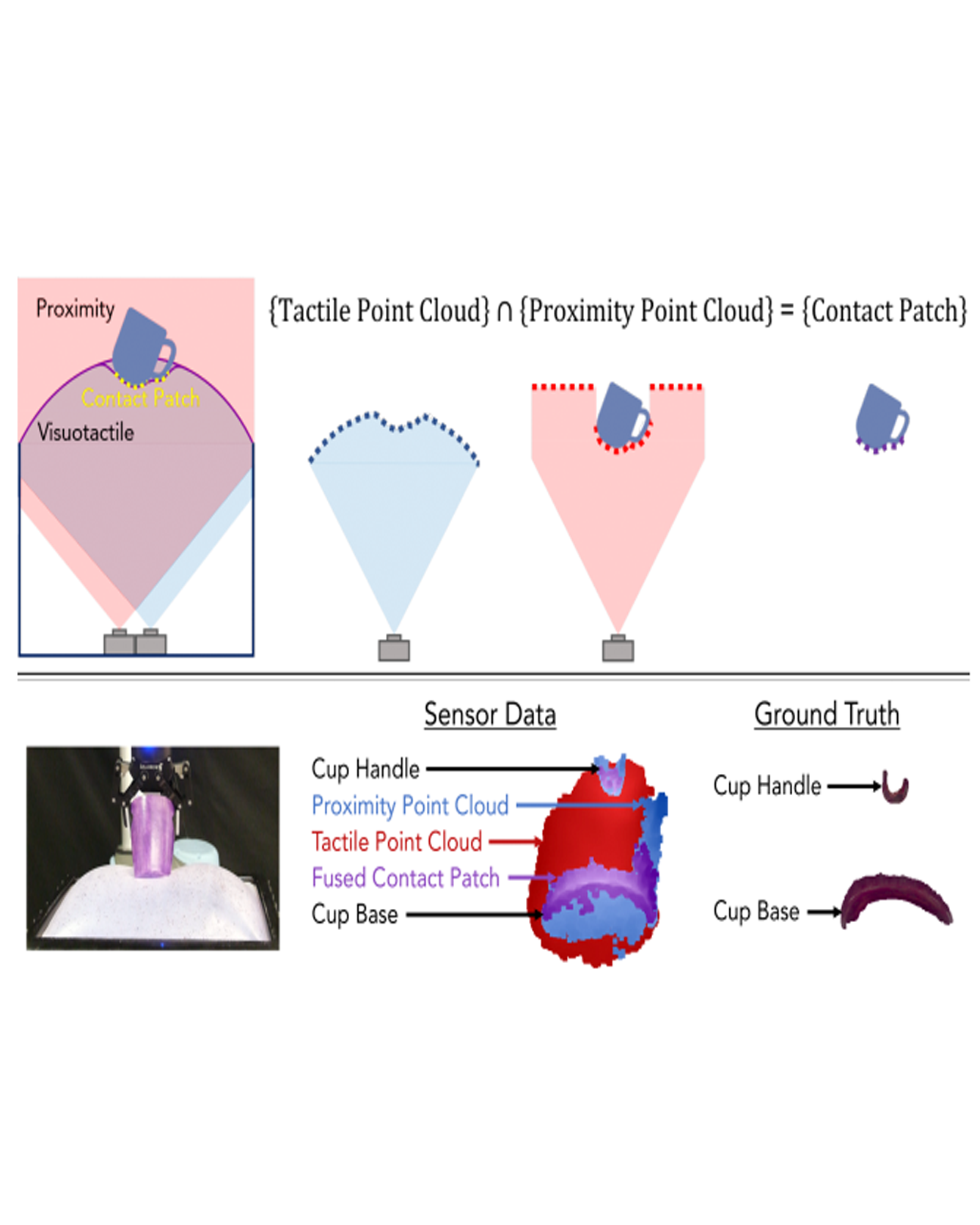
Visuotactile sensors are a popular tactile sensing strategy due to high-fidelity estimates of local object geometry. However, existing algorithms for processing raw sensor inputs to useful intermediate signals such as contact patches struggle in high-deformation regimes. This is due to physical constraints imposed by sensor hardware and small-deformation assumptions used by mechanics-based models. In this work, we propose a fusion algorithm for proximity and visuotactile point clouds for contact patch segmentation, entirely independent from membrane mechanics. This algorithm exploits the synchronous, high spatial resolution proximity and visuotactile modalities enabled by an extremely deformable, selectively transmissive soft membrane, which uses visible light for visuotactile sensing and infrared light for proximity depth. We evaluate our contact patch algorithm in low (10%), medium (60%), and high (100%+) strain states. We compare our method against three baselines: proximity-only, tactile-only, and a first principles mechanics model. Our approach outperforms all baselines with an average RMSE under 2.8 mm of the contact patch geometry across all strain ranges. We demonstrate our contact patch algorithm in four applications: varied stiffness membranes, torque and shear-induced wrinkling, closed loop control, and pose estimation.
Achieving robust dexterous manipulation in unstructured domestic environments remains a significant challenge in robotics. Even with state-of-the-art robot learning methods, haptic-oblivious control strategies (i.e. those relying only on external vision and/or proprioception) often fall short due to occlusions, visual complexities, and the need for precise contact interaction control. To address these limitations, we introduce PolyTouch, a novel robot finger that integrates camera-based tactile sensing, acoustic sensing, and peripheral visual sensing into a single design that is compact and durable. PolyTouch provides high-resolution tactile feedback across multiple temporal scales, which is essential for efficiently learning complex manipulation tasks. Experiments demonstrate an at least 20-fold increase in lifespan over commercial tactile sensors, with a design that is both easy to manufacture and scalable. We then use this multi-modal tactile feedback along with visuo-proprioceptive observations to synthesize a tactile-diffusion policy from human demonstrations; the resulting contact-aware control policy significantly outperforms haptic-oblivious policies in multiple contact-aware manipulation policies. This paper highlights how effectively integrating multi-modal contact sensing can hasten the development of effective contact-aware manipulation policies, paving the way for more reliable and versatile domestic robots. More information can be found at this https URL.

There are growing discussions within the research community about how to adapt study design given the widespread availability of Generative Artificial Intelligence (GenAI), including Large Language Models (LLMs). While much prior research has focused on LLM use from a researcher perspective (e.g. detecting and screening for LLM use) we present a complementary study from the perspective of participants who use LLMs during their research participation. In this exploratory interview study with 17 participants, we found a range of LLM use cases, from sourcing studies, to generating or modifying responses, to asking clarification questions about studies. We also explored participants’ ethical considerations, finding that participants considered researchers’ needs for authentic data when setting ethical boundaries. Participants also discussed how attempts to thwart their LLM use have negatively impacted their everyday participant experience. We propose a set of recommendations that researchers can incorporate into their studies to proactively address participant LLM use.

Diffusion models have made substantial progress in facilitating image generation and editing. As the technology matures, we see its potential in the context of driving simulations to enhance the simulated experience. In this paper, we explore this potential through the introduction of a novel system designed to boost visual fidelity. Our system, DRIVE (Diffusion-based Realism Improvement for Virtual Environments), leverages a diffusion model pipeline to give a simulated environment a photorealistic view, with the flexibility to be adapted for other applications. We conducted a preliminary user study to assess the system’s effectiveness in rendering realistic visuals and supporting participants in performing driving tasks. Our work lays the groundwork for future research on the integration of diffusion models in driving simulations, and provides practical guidelines and best practices for their application in this context.

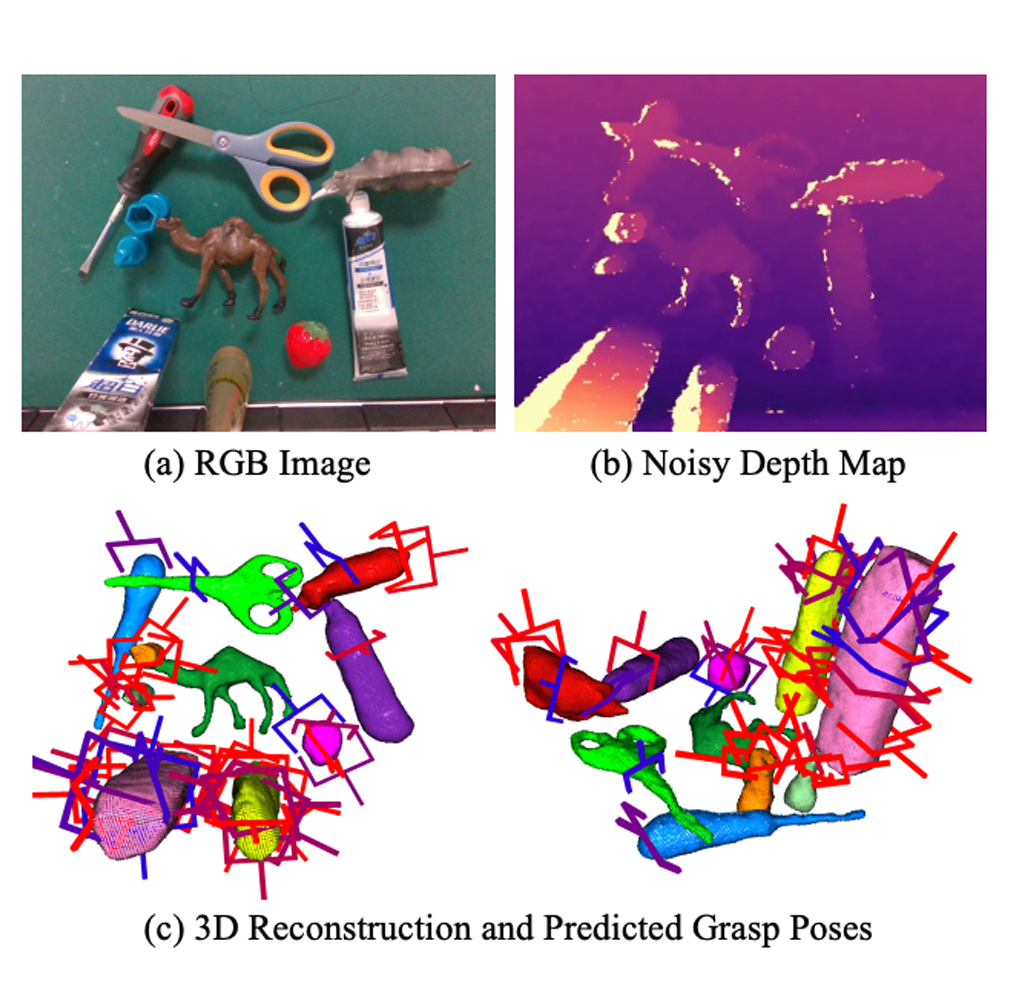
Robotic grasping is a cornerstone capability of embodied systems. Many methods directly output grasps from partial information without modeling the geometry of the scene, leading to suboptimal motion and even collisions. To address these issues, we introduce ZeroGrasp, a novel framework that simultaneously performs 3D reconstruction and grasp pose prediction in near real-time. A key insight of our method is that occlusion reasoning and modeling the spatial relationships between objects is beneficial for both accurate reconstruction and grasping. We couple our method with a novel large-scale synthetic dataset, which comprises 1M photo-realistic images, high-resolution 3D reconstructions and 11.3B physically-valid grasp pose annotations for 12K objects from the Objaverse-LVIS dataset. We evaluate ZeroGrasp on the GraspNet-1B benchmark as well as through real-world robot experiments. ZeroGrasp achieves state-of-the-art performance and generalizes to novel real-world objects by leveraging synthetic data. READ MORE