Featured Publications
All Publications

Autonomous vehicle controllers capable of drifting can improve safety in dynamic emergency situations. However, drifting involves operating at high sideslip angles, which is a fundamentally unstable operating regime that typically requires an accurate vehicle model for reliable operation; such models may not be available after environmental or vehicle parameter changes. Towards that goal, this work presents a Nonlinear Model Predictive Control approach which is capable of initiating and controlling a drift in a production vehicle even when changes in vehicle parameters degrade the original model. A neural network model of the vehicle dynamics is used inside the optimization routine and updated with online learning techniques, giving a higher fidelity and more adaptable model. Experimental validation on a full size, nearly unmodified Lexus LC500 demonstrates the increased modeling fidelity, adaptability, and utility of the presented controller framework. As the LC500 is a difficult car to drift, previous approaches which rely on physics based vehicle models could not complete the autonomous drift tests on this vehicle. Furthermore, the tires on the experimental vehicle are then switched, changing the vehicle parameters, and the capability of the controller to adapt online is demonstrated. READ MORE

Vehicles capable of operating up to the limits-of-handling can improve safety in emergency maneuvers. In light of this, this work proposes a method to robustly anticipate when a vehicle approaches its limits-of-handling and safely contain the vehicle dynamics to within these limits. First, input-to-state stable nonlinear observers are designed to estimate errors in the dynamics of a nominal vehicle model. These errors are translated into improved estimates of tire-road forces for real-time detection of tire saturation. Next, a robustifed control barrier function based quadratic program (RCBF-QP) is designed to filter control commands of a nonlinear model predictive controller that uses the nominal vehicle model for prediction. The observed model errors are incorporated into the RCBF-QP to create robustified safety-critical constraints that maintain the vehicle dynamics within the limits-of-handling. The observers and the RCBF-QP are experimentally validated on a full-scale vehicle and demonstrate the ability to retain motion control at the handling limits despite modeling errors. READ MORE
With advances in vehicle modeling and control, intelligent vehicles can increasingly utilize the full vehicle capabilities should it be necessary for safety. This paper presents a shared control approach capable of operating in the open-loop unstable state space of a vehicle. First the Maximal Phase Recoverable Parallelogram is defined as the state space where a control action exists that can stabilize the vehicle. An online approach to constructing a subset of the Maximal Phase Recoverable Parallelogram that avoids spinning out past a desired sideslip is presented. This then forms a safety envelope for a Nonlinear Model Predictive Control framework for shared control. The shared control formulation is designed to match driver inputs, unless inputs lead to safety violations such as a spin or track bound violation. If intervention is needed, the controller seeks to follow the drivers intent in a safe manner. Results for a full scale experimental vehicle executing circular steady-state drifting demonstrate the ability of the controller to operate in the open-loop unstable drifting regime and limit intervention unless there is a risk of spinning out or violating track bounds. This shared control approach is a step towards assisting a driver in using a vehicle’s full capabilities even in extreme maneuvers. READ MORE
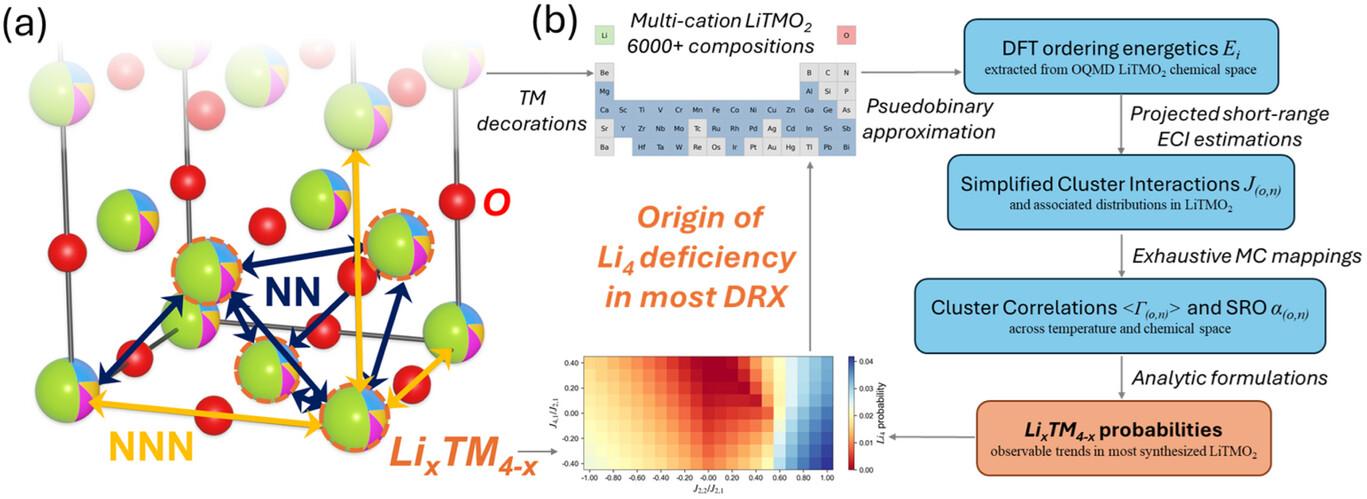
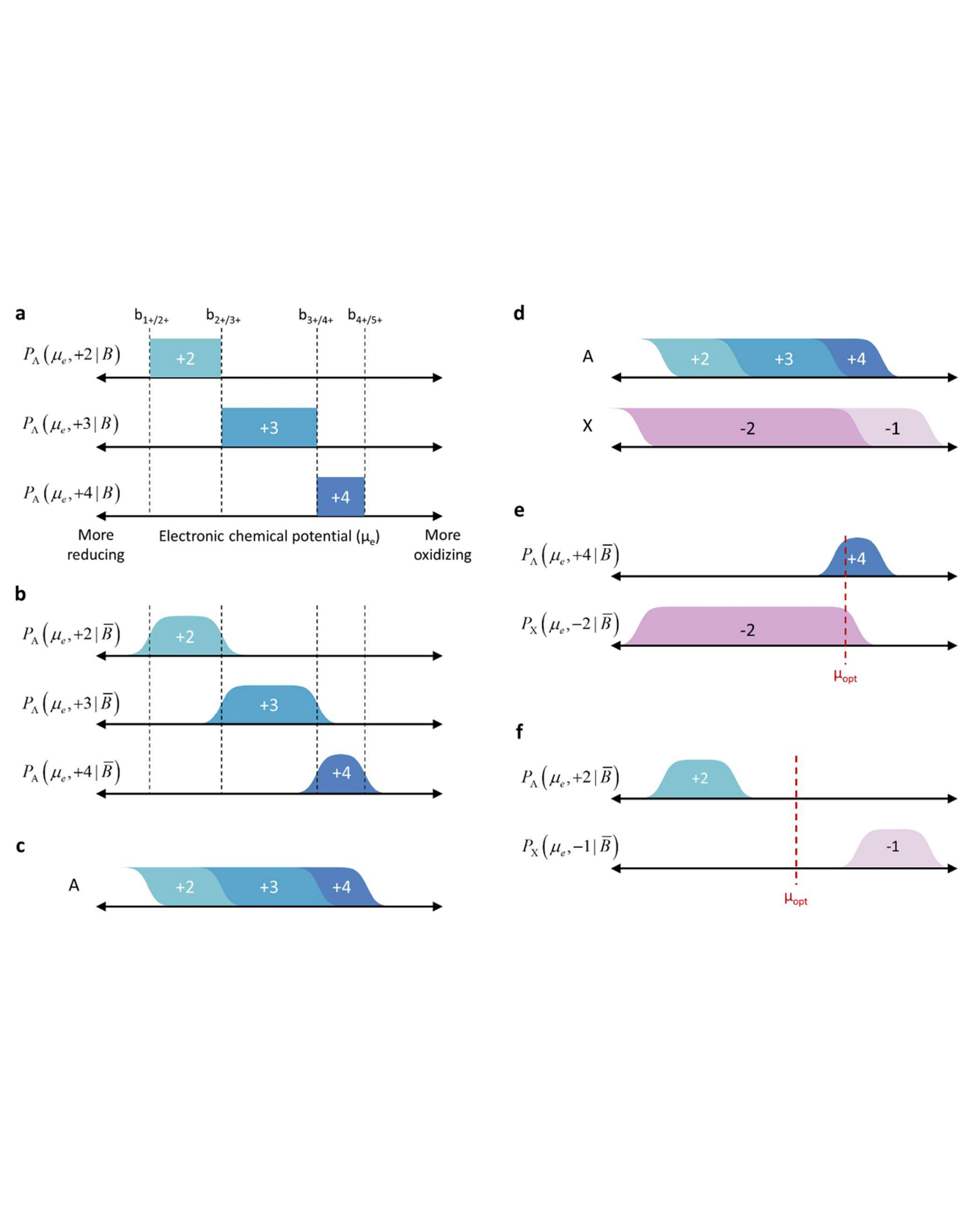
The electrochemical series is a useful tool in electrochemistry, but its effectiveness in materials chemistry is limited by the fact that the standard electrochemical series is based on a relatively small set of reactions, many of which are measured in aqueous solutions. To address this problem, we have used machine learning to create an electrochemical series for inorganic materials from tens of thousands of entries in the Inorganic Crystal Structure Database. We demonstrate that this series is generally more consistent with oxidation states in solid-state materials than the series based on aqueous ions. The electrochemical series was constructed by developing and parameterizing a physical, human-interpretable model of oxidation states in materials. We show that this model enables the prediction of oxidation states from composition in a way that is more accurate than a state-of-the-art transformer-based neural network model. We present applications of our approach to structure prediction, materials discovery, and materials electrochemistry, and we discuss possible additional applications and areas for improvement. To facilitate the use of our approach, we introduce a freely available website and API. READ MORE
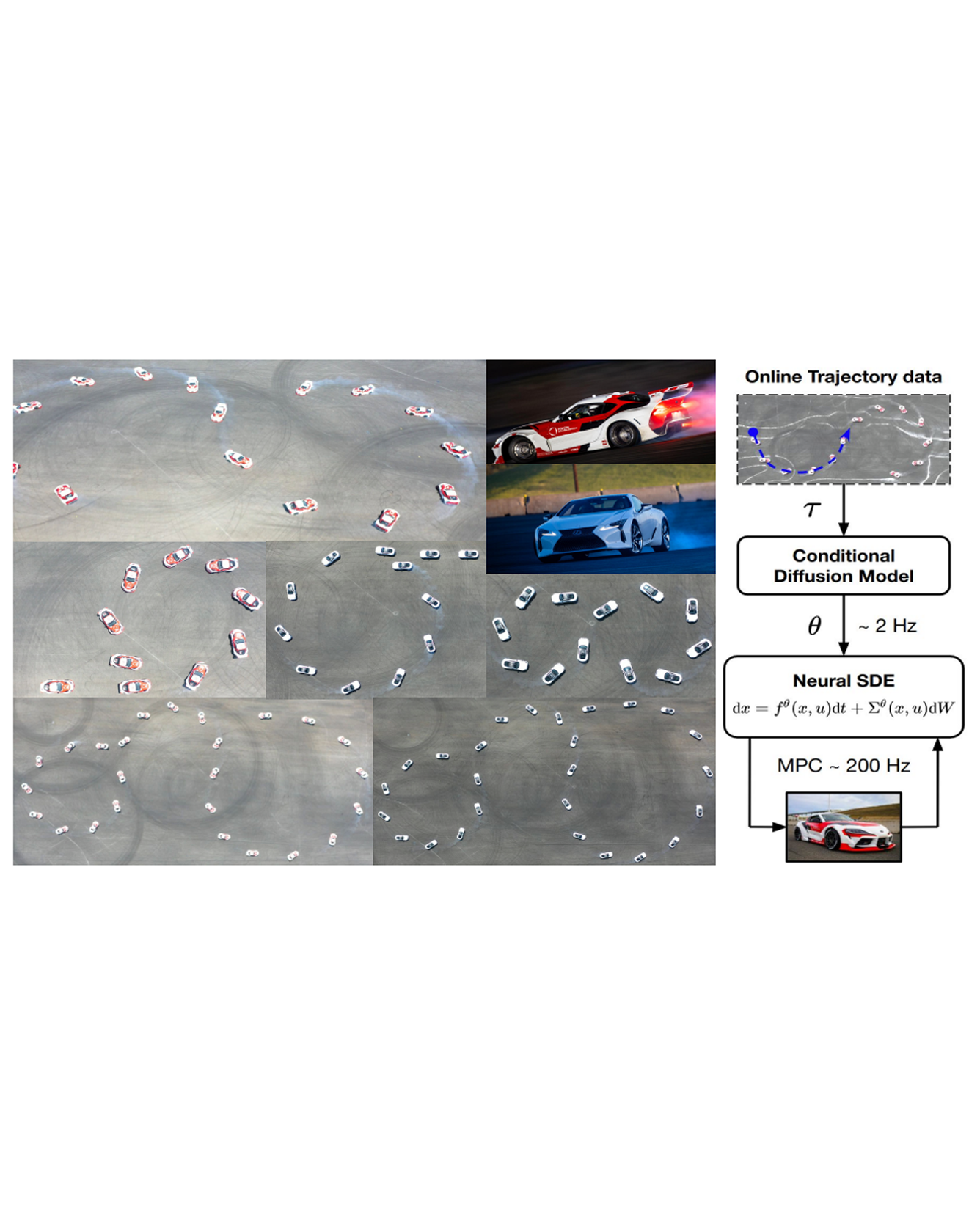
Enabling autonomous vehicles to reliably operate at the limits of handling— where tire forces are saturated — would improve their safety, particularly in scenarios like emergency obstacle avoidance or adverse weather conditions. However, unlocking this capability is challenging due to the task’s dynamic nature and the high sensitivity to uncertain properties of the road, vehicle, and their dynamic interactions. Motivated by these challenges, we propose a framework to learn a conditional diffusion model for high-performance vehicle control using an unlabelled dataset containing trajectories from distinct vehicles in different environments. We design the diffusion model to capture the complex dataset’s trajectory distribution through a multimodal distribution of parameters of a physics-informed data-driven dynamics model. By conditioning the generation process on online measurements, we integrate the diffusion model into a real-time model predictive control framework for driving at the limits, and show that it can adapt on the fly to a given vehicle and environment. Extensive experiments on a Toyota Supra and a Lexus LC 500 show that a single diffusion model enables reliable autonomous drifting on both vehicles when operating with different tires in varying road conditions. The model matches the performance of task-specific expert models while outperforming them in generalization to unseen conditions, paving the way towards a general, reliable method for autonomous driving at the limits of handling. READ MORE
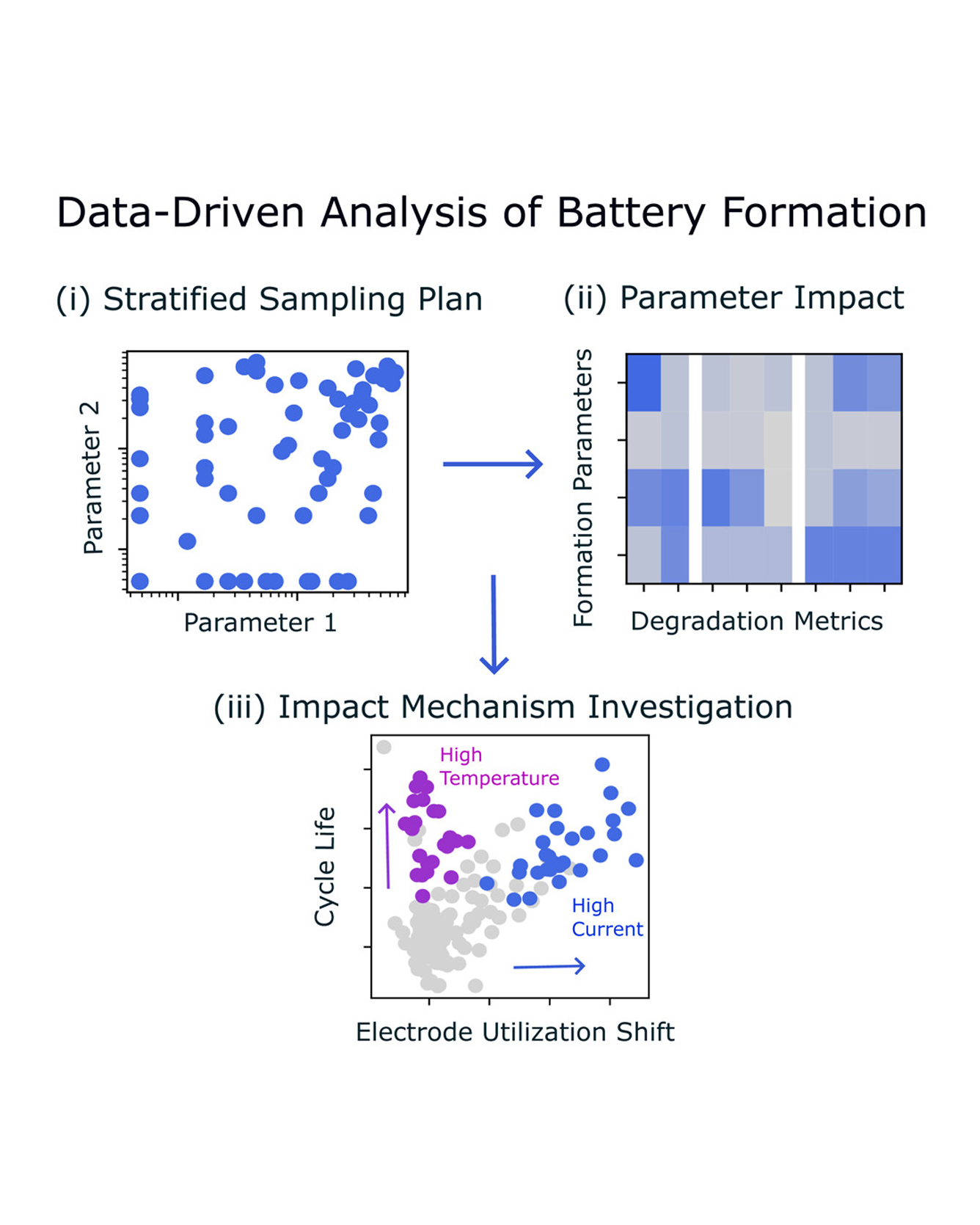
Formation is a critical step in battery manufacturing. During this process, lithium inventory is consumed to form the solid electrolyte interphase (SEI), which in turn determines the battery lifetime. To tackle the vast parameter space and complexity of formation, we employ a data-driven workflow on 186 lithium-ion battery cells across 62 formation protocols. We identify two key parameters, formation charge current and temperature, that control battery longevity via distinct mechanisms. Surprisingly, high-formation charge current on the first cycle extends battery cycle life by an average of 50%. Unlike elevated formation temperature, which boosts battery performance by forming a robust SEI, the cycle life improvement for fast-formed cells arises from a shifted electrode-specific utilization after formation. Apart from the widely acknowledged role of formation in governing SEI properties, we demonstrate how formation protocols determine the stoichiometry range over which the positive and negative electrodes are cycled. READ MORE
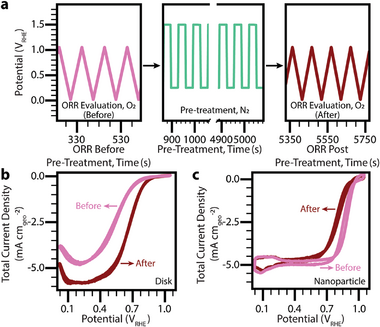
Activation, break-in, and/or pre-treatment protocols are generally applied to energy conversion devices before regular operation to reach stable performance. There remains much to understand about the relationships among physical properties, performance, and electrochemical pre-treatments. Here, a design-of-experiments (DoE) strategy is employed to address this gap by demonstrating the influence of five pre-treatment parameters for carbon-supported Pt-nanoparticle catalysts on the electrocatalytic oxygen reduction reaction (ORR). A subset of pre-treatments, developed using a central composite design, are tested in a flow cell combined with an inductively-coupled plasma mass spectrometer (on-line ICP-MS). The DoE-based approach facilitates comprehensive insights from two orders of magnitude fewer experiments than a conventional grid search. The coupled on-line ICP-MS setup enables effective catalysis and real-time catalyst dissolution data. Leveraging insights from DoE for on-line ICP-MS and additional characterization, a model is built between the degradation of a multi-dimensional supported Pt surface, its performance, and applied electrochemical parameters. These investigations identify surface modifications, such as oxidation, and subsequent restructuring of Pt during pre-treatment as a primary cause of performance deterioration during ORR. By combining DoE with advanced characterization techniques, a powerful approach is demonstrated to gain a mechanistic understanding of pre-treatment protocols that can be broadly adapted to various reaction chemistries.
The composition and morphology of the cathode catalyst layer (CCL) have a significant impact on the performance and stability of polymer electrolyte membrane fuel cells (PEMFC). Understanding the primary degradation mechanism of the CCL and its influencing factors is crucial for optimizing PEMFC performance and durability. Within this work, we present comprehensive in-situ characterization data focused on cathode catalyst degradation. The dataset consists of 36 unique durability tests with over 4000 testing hours, including variations in the cathode ionomer to carbon ratio, platinum on carbon ratio, ionomer equivalent weight, and carbon support type. The applied accelerated stress tests were conducted with different upper potential limits and relative humidities. Characterization techniques including IV-curves, limiting current measurements, electrochemical impedance spectroscopy, and cyclic voltammetry were employed to analyse changes in performance, charge and mass transfer, and electrochemically active surface area of the catalyst. The aim of the dataset is to improve the understanding of catalyst degradation by allowing comparisons across material variations and provide practical information for other researchers in the field. READ MORE
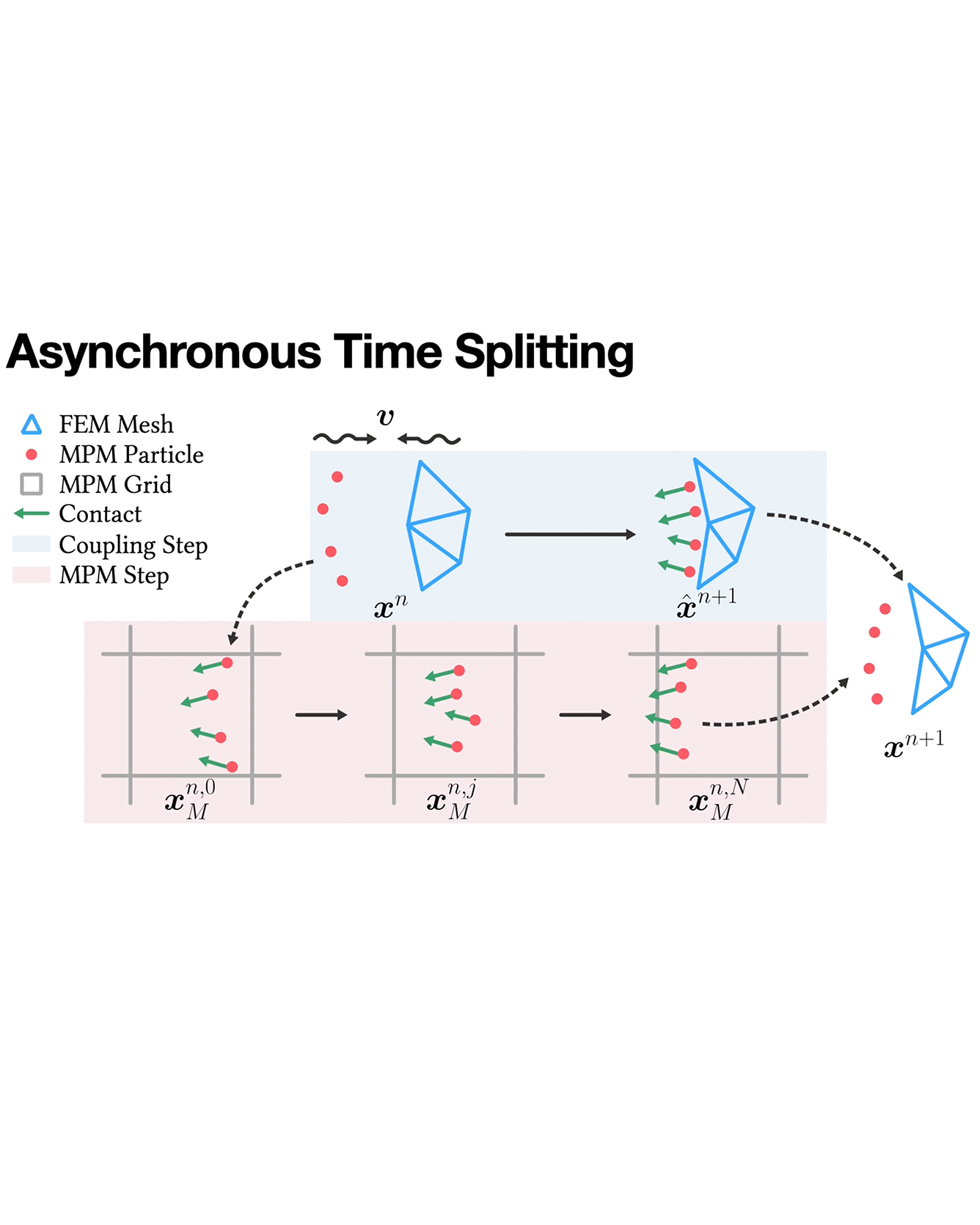
This paper presents a novel method to couple Finite Element Methods (FEM), typically employed for modeling Lagrangian solids such as flesh, cloth, hair, and rigid bodies, with Material Point Methods (MPM), which are well-suited for simulating materials undergoing substantial deformation and topology change, including Newtonian/non-Newtonian fluid, granular materials, and fracturing materials. The challenge of coupling these diverse methods arises from their contrasting computational needs: implicit FEM integration is often favored to enjoy stability and large timesteps, while explicit MPM integration benefits from its allowance for efficient GPU optimization and flexibility of applying different plasticity models, which only allows for moderate timesteps. To bridge this gap, a mixed implicit-explicit time integration (IMEX) approach is proposed, utilizing principles from time splitting for partial differential equations and optimization-based time integrators. This method adopts incremental potential contact (IPC) to define a variational frictional contact model between the two materials, serving as the primary coupling mechanism. Our method enables implicit FEM and explicit MPM to coexist with significantly different timestep sizes while preserving two-way coupling. Experimental results demonstrate the potential of our method as a strong foundation for future exploration and enhancement in the field of multi-material simulation. READ MORE
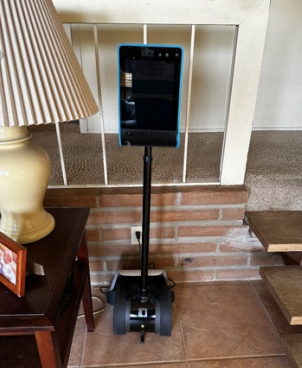
Mobile telepresence robots can help reduce loneliness by facilitating people to visit each other and have more social presence than visiting via video or audio calls. However, using new technology can be challenging for many older adults. In this paper, we examine how older adults use and want to use mobile telepresence robots, how these robots affect their social connection, and how they can be improved for older adults’ use. We placed a mobile telepresence robot in the home of older adult primary participants (N = 7; age 60+) for 7 months and facilitated monthly activities between them and a secondary participant (N = 8; age 18+) of their choice. Participants used the robots as they liked between monthly activities. We collected diary entries and monthly interviews from primary participants and a final interview from secondary participants. Results indicate that older adults found many creative uses for the robots, including conversations, board games, and hide ‘n’ seek. Several participants felt more socially connected with others and a few had improved their comfort with technology because of their use of the robot. They also suggested design recommendations and updates for the robots related to size, mobility, and more, which can help practitioners improve robots for older adults’ use. READ MORE