Elevating Human Growth: Human-AI Kaizen Initiative
2 Minute ReadBy Matthew Lee, Program Director, Human-AI Kaizen Initiative
Today, Toyota Research Institute (TRI) announces the proposals selected for the Human-AI Kaizen Initiative, a multi-year collaboration with leading North American universities dedicated to reshaping how people and AI systems collaborate, grow, and co-evolve together. At TRI, we believe AI should amplify human ability, not replace it, and that belief is at the heart of our Human-Centered AI (HCAI) division leading this initiative.
The name draws on kaizen, the philosophy of continuous improvement central to the Toyota Production System. As AI continues to change the nature of work, we believe there is a fundamental need for people to continually develop their skills and abilities to adapt and contribute meaningfully to society. This initiative is guided by a central question: as AI assumes more of our routine tasks, how can we help people build their judgment, adaptability, and capabilities alongside it?
From 194 proposals to four collaborations
We launched the call for proposals in June 2025, inviting researchers across North America to help us tackle this challenge. The response exceeded our expectations: we received 194 proposals from more than 70 universities, spanning disciplines from computer science and machine learning to psychology, anthropology, and philosophy. After a rigorous, multi-stage review, we selected four collaboration proposals, each co-led by a TRI researcher working as a peer alongside the university team.
The selected projects:
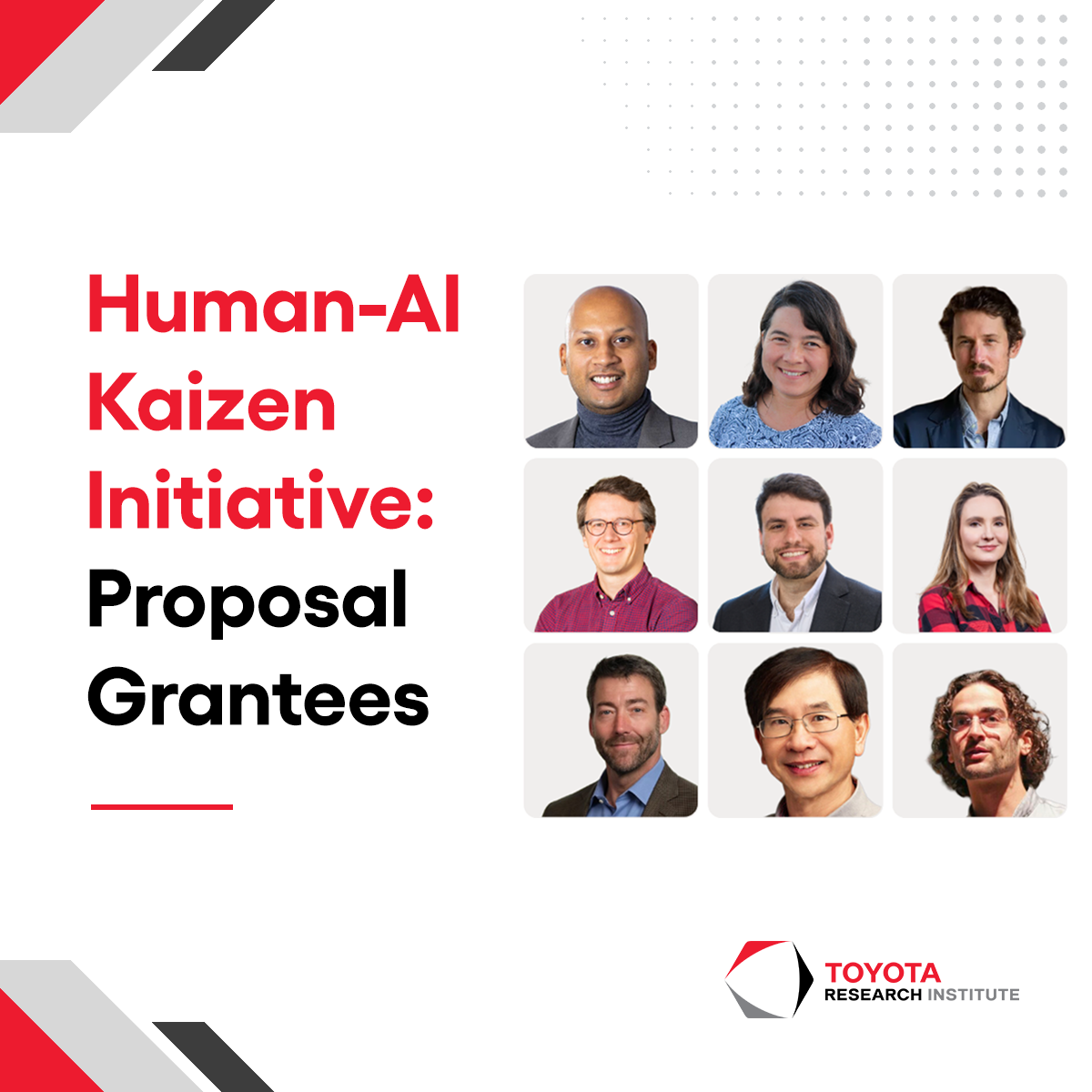
University of Washington — “Kaizen Thought Partners: Pluralistic AI That Empowers and Adapts to People,” Natasha Jaques and Max Kleiman-Weiner. TRI co-investigator: Arash Khajeh.
Stanford University — “Adaptive Responsibility in Human-AI Collaboration,” Tobias Gerstenberg, Thomas Icard, and Noah Goodman. TRI co-investigator: Scott Mueller.
UC San Diego — “User-Sensitive AI Through Multimodal Neurophysiology,” Ying Choon Wu and Tzyy-Ping Jung. TRI co-investigator: Pablo E. Paredes.
USC Information Sciences Institute — “(AI)nthropology in Action: The Mechanics of Human-AI Co-Evolution,” Mayank Kejriwal and Adam Russell. TRI co-investigator: Matthew Lee.
What's next
Over the course of the program, we will share updates from these collaborations as the research progresses. The research ranges from deeply technical advancements in AI to anthropological insights into how to support individuals in organizations to grow. We will explore developing ML algorithms that advance both productivity and human growth, foundational models for measuring cognitive states that support growth, and building a deep understanding of how to support organizations in co-evolving with AI.
“While other programs focus mainly on advancing AI capabilities, the Human-Centered AI Kaizen Initiative centers on the human to co-evolve and stay one step ahead of AI,” said Matthew Lee, Senior Manager & Staff Research Scientist at Toyota Research Institute, leading the initiative. “We aim to grow people’s skills and abilities with AI systems that enhance both short-term productivity and, more importantly, long-term empowerment.”
Our hope is that this program can sow the seeds for a consortium of researchers dedicated to creating a positive future for human-AI collaborations, where people continually grow in their skills and abilities to meet societal challenges.
Learn more about the Human-AI Kaizen Initiative on our website.